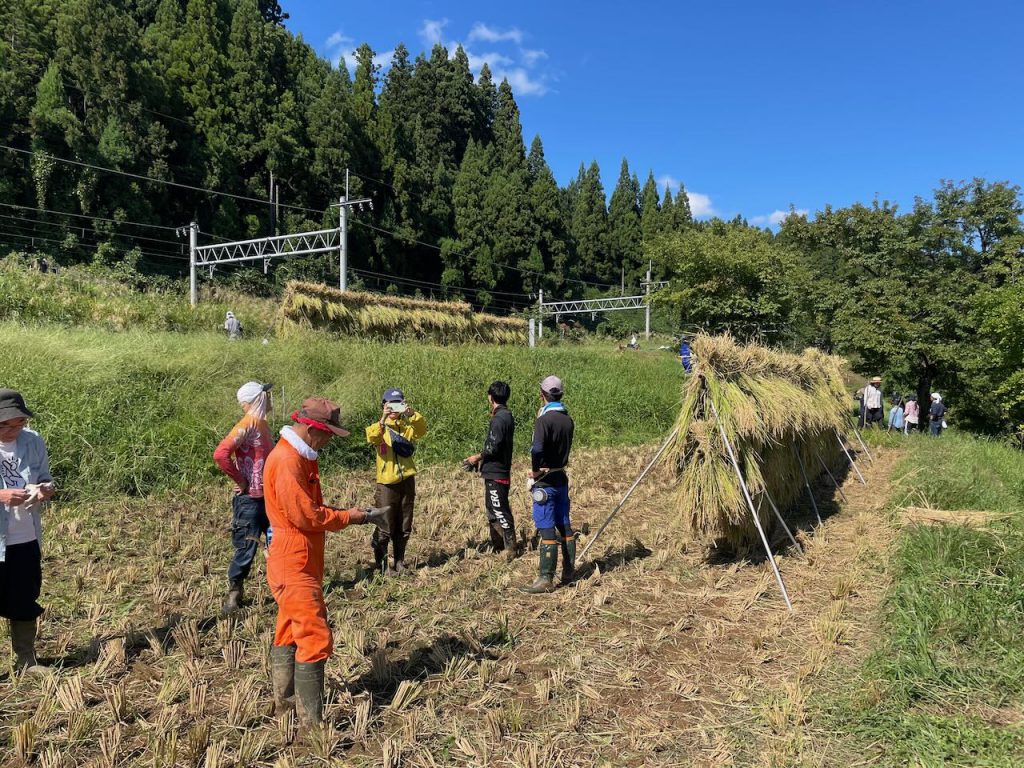
We enjoyed the rice harvesting workshop of “The ABCs in Rice Paddies” with 15 participants on September 20-21, 2025, in the Kabanozawa village of Minamiuonuma City. Due to the unstable weather, we changed our plans and harvested rice on the 20th. On the 21st, amidst pouring rain, we observed a local farmer’s “rice preparation” work and learned about the current state of rice farming.
With only 35 millimeters of rainfall in July, less than 20% of the average, the rice paddies in Minamiuonuma were left cracked and in terrible condition. Rain finally came in early August, providing some relief, but temperatures remained over two degrees higher than average throughout the summer. The two pesticide-free paddies that we tended to through planting and weeding, following the basics of rice farming, have shorter stalks and fewer stems than last year.
On the 20th, rain was forecast for the evening, so we quickly finished lunch and headed to the fields to start harvesting. We began cutting the rice with sickles. The tricky part was bundling the cut rice. After listening to explanations from veterans who had participated several times before, we each struggled but managed to finish making rice bundles.
Occasionally, sunlight filters through the blue sky. A strong wind blows from the south, causing the rice stalks to sway like waves. During breaks, we were soothed by the sounds of insects like crickets while gazing at the rice fields stretching out before us.
Work progressed smoothly, and the first field was finished in about two hours. “We still have time, let’s do it,” said one participant. We started harvesting the second field. Everyone was getting the hang of it, and roles naturally divided: some cut, some bundled, some carried, and some hung the bundles on the drying racks. In just one hour, we neatly harvested half the field.
Heavy rain fell on the second day, starting in the early morning. We split up and rode in cars to visit the Tochikubo village, which was located about 300 meters higher in elevation. During a break in the rain, we toured the rice paddies and explored the beech forest.
At local farmer HIGUMA Keiichi’s workshop, the “adjustment” process was underway: removing moisture from the harvested rice, dehusking it, removing stones and other foreign objects, and sorting out small or discolored grains. “This year’s rice is beautiful,” he said, showing us the finished product.
Japan Agriculture’s purchase price for rice has risen from ¥20,000 last year to ¥33,000 this year in Minamiuonuma. Furthermore, an additional ¥4,000 seems to have been added in September. During the discussion session after the tour, veteran local farmer Kato Yoshiharu explained the current situation, stating: “The latest combine harvesters can cost as much as 25 million yen. Considering the price of machinery, farms of the previous scale simply can’t survive.”
In recent years, particularly, unstable weather patterns, including abnormal heat, droughts, and prolonged rains, have persisted, leading to ongoing instability in the quality and quantity of rice. Even if we aim to increase production, expanding the rice fields isn’t something we can easily do.
Mr. HIGUMA lamented, “I heard the minister came to Minamiuonuma City to inspect the drought situation, so I called city hall. They said no special budget measures were allocated. He just came to look.” Hearing this, the participants also felt the severity of the rice problem.
During a visit to a local supermarket, locally grown new-crop brown rice was being sold for 10,000 yen per 10kg bag. “At this price locally, it’s no wonder they charge 7,000 yen for 5kg in the Tokyo,” someone remarked.
On the weekend of June 21-22, 2025, ECOPLUS conducted a weeding workshop in Minamiuonuma City, Niigata Prefecture, with nine participants ranging from babies to the elderly.
On Saturday, June 21, we visited the highest rice field in the city, located in the Tochikubo Village. The tour began with a visit to a reservoir into which spring water from the mountains flows, and the participants learned how the water travels through the terraced rice paddies one by one.
We also found the bubbling eggs of tree frogs on the branches of a 5-meter-high tree adjacent to the rice paddies.
We also observed the site of mowing, the slope between paddies, which is a significant challenge for rice cultivation in terraced rice paddies. We were amazed to see the huge slope, which was about three times taller than our height.
On Sunday, June 22, weeding was done under fine weather, with temperatures exceeding 30 degrees Celsius, but the soil in the rice paddies was slightly cool to the touch. We could clearly see the difference between the temperature of the soil and that of the hot spring-like temperature on the surface.
We spent a total of three hours fighting with the weeds that were growing around the roots of the rice seedlings, which had grown to a height of about 30 centimeters. 150 square meters of small rice field was beautifully cleaned. A rice ball lunch was served next to the rice paddy.
In the pesticide-free rice paddies, we were able to see many living creatures, including the Moreton’s damselfly and the red-bellied newt. Both are listed as endangered species 1A in the Kanto Plain and other areas.
Weeding of the pesticide-free rice fields will be necessary one or two more times until around July. They returned home with their voices saying, “I will come back to weed the fields on my own!” Thank you very much.
On the weekend of May 25 and 26, 2024, an Ecoplus Weekend Farming Workshop, “ABC in a Rice Paddy,” was held in Minamiuonuma City, Niigata Prefecture. Nineteen people from the Tokyo metropolitan area, Yamagata and Nagano prefectures participated, ranging from families with elementary school children to university students, young professionals, and senior citizens. Local farmers also supported the event. Under a blue sky, the participants enjoyed farming in chemical-free rice paddies while admiring the dazzling fresh green of Uonuma’s nature.
On the first day, we climbed to the 700-meter-high mountain pass commonly called “Kannon-sama” overlooking the Uonuma Basin to get an overall view of the Uonuma Basin. The mountains on the border of Gunma and Fukushima prefectures were clearly visible in the distance. A number of rare species of butterflies called “Gifucyo” danced around us. On the way back from the pass, we walked along the “old road” that UESUGI Kenshin took when he marched in the Kanto region. We actually walked through the terrain where the land had been hollowed out by the soldiers and horses, and we were reminded of the scene nearly 500 years ago.
The second day, we worked in the rice paddies. In one corner of the rice field were four seedbeds the size of one tatami mat. There, seedlings about 10 centimeters tall were growing in tight rows. Nowadays, seedlings are usually grown in greenhouses with warm conditions, and open-air “water seedbeds” have almost disappeared.
We took on the challenge of removing seedlings from this water nursery, a task that was commonplace until about 50 years ago. Bending over at the waist with both hands outstretched, we scooped out the seedlings as if we were scooping up the soil. The wild millet seedlings were growing in the seedbeds, so we had to identify and remove the millet seedlings. Both were so similar. The participants were challenged to identify the differences.
In the rice field where the rice was to be planted, a hexagonal wooden frame is rolled out to make a mark, and the seedlings are planted on the marks. The work of taking the seedlings, carrying them, and planting them unfolded fluidly as we all found ourselves sharing the work.
In about three hours, we finished the planting of about 150 square meters of rice. The participants then enjoyed a lunch of onigiri (rice balls) at the edge of the rice paddy. Participants left comments such as, “The feeling of putting my hands and feet in the mud made me wonder why I felt so happy,” and “I now understand how rice is grown.
The organic rice farming program in Tochikubo Village, which we have been organizing since 2007, can no longer continue. This is because the community farming organization has ceased operations due to the aging of the farmers.
Meanwhile, in Tochikubo, HIGUMA Keiichi, a farmer in his thirties, has started to work as a full-time farmer. With the support of his senior farmers, he has successfully managed the daily tasks of plowing with a tractor, daily water management, mowing of the edges, and processing the harvested rice, and has produced excellent rice.
Last year, we had a harsh climate with no rain from late July to the end of August. Only less than 5% of the Koshihikari rice in Niigata was first class, but Higuma’s rice was all first class.
The rice is “reduced pesticide rice,” which means that herbicides and other pesticides are not used. The price is 700 yen per kilo for brown rice, 800 yen per kilo for white rice, and shipping costs are not included.
ECOPLUS conducted the weekend farming workshop, “ABC in a rice paddy,” harvesting work, on 23-24 September 2023. Under the very unusual hot weather conditions, we learned about nature and agriculture in Shiozawa area, which is the heartland of famous Koshihikari rice, and enjoyed harvesting work by hand in non-chemical rice paddies.
標高500mの田んぼの脇でサワガニ発見 identified a fresh water crab
若手農家から今年の出来を聞く Hearing about the evaluation of rice of the year from a young farmer
稲刈りの田んぼの回りで自然観察 Observation of the nature around the rice paddies.
On Saturday, the 23rd, the weather was a bit wet. We went to the top of the hill called “Kwanon-sama” at an altitude of 700 meters to observe the Uonuma Basin. Rice fields with yellow (not yet harvested), brown (just harvested) and green (more than weeks after harvest with weeds) made a beautiful patchwork. The soil of the hill is raised seabed that provides minerals to the snow melted water in the spring. These minerals give the best flavor to the rice grown here.
On Sunday the 24th we started harvesting under a beautiful blue sky. Among the 22 participants, only some had the experience of harvesting with sickles. They cut the bottom part of the rice stalks with sickles, then laid on the edge, crossed the bottom part in X-shape, then bundled two into one with dried straws. This was the most difficult part. Making the X shape makes it easier to hang the sheaf on the pole. One commented, “I understood that not only cutting, but also bundling and hanging must be done in one line.
By 1 pm, which took 4 hours from the beginning, the harvesting works of two rice paddies were completed. We set lunch place on the edge. Taking rice balls of newly harvested rice by the inn, all of us enjoyed talking about the value of rice and the beautiful environment in this area.
On September 23 and 24, ECOPLUS will conduct “Rice Harvesting Workshop” in Tochikubo village, Minamiuonuma as two-day program, only with those who are PCR test negatives.
Summary Experience Japanese traditional rice harvesting by hands in organic rice paddy overseeing gorgeous mountainous view. Set your body and mind free in the safe open air. You may also deepen the insight of rice and agriculture through the workshop, as well as Japanese history and society.
Schedule Gathering; 11:00 am on September 23, at our accommodations, “Chateau Shiozawa.” The nearest railway station is Shiozawa on JR Joetsu line. Let us know if you use rain, so that we will arrange transportation to the hotel.
交通案内 23日午前8時52分東京駅発とき309号、10時21分越後湯沢着 10時30分越後湯沢発上越線普通列車長岡行、10時47分塩沢着 Joetsu Shinkansen Toki 309 Departing Tokyo at 08:52, arriving Echigo-Yuzawa at 10:21 Joetsu local line Departing Echigo-Yuzawa at 10:30, arriving Shiozawa at 10:47
Contents and bringing Harvasting rice by sickles by hands. Will be cancelled only in stormy condition. Bring your own lunch for day one. Clothings may get muddy. Insect repellent, a hat/cap. The boots are needed since it is very muddy. The participation guide will be provided for those whose participation is confirmed.
定員 Limit of participants. 20人をめどとします。Up to 20 participants.
参加費 Fee 18,500円(プログラム費、1泊2食の宿泊費、2日目の昼食、保険を含む)。男女別相部屋です。ご家族連れは調整させていただきます。1人部屋使用の場合は、1,000円増し。中学生以上大学生までは、13,500円。小学生は9,500円。地元からの参加で宿泊しない場合は、大人9,500円、学生4,500円、小学生は1,000円。 18,500 JPY including program fee, accommodations with two meals, lunch on Sunday, insurance. Shared room. Single room available with extra 1,000 JPY. 13,500 JPY for students from Junior high to college, 9,500 JPY for primary school students.
申し込み Application 下のフォームからお申し込み下さい。Please use below application form. 問い合わせは、tappo@ecoplus.jpまで。If needed contact to tappo@ecoplus.jp
We are starting to accept orders of sun-dried organic ice grown in our non-chemical rice paddies in Tochikubo village in Niigata. The rice which will be harvested and dried under the sun, will be delivered in November.
From the planting of seedlings to weeding and harvesting, ECOPLUS has been organizing workshops. Very limited amount of this precious rice will be available for sale.
No chemical materials, like pesticides and weed killers, were used. Fertilizer is 100% organic. Traditional sun drying process on the rack was taken. Because of so many hand works, such totally organic rice is almost vanished even in this Minamiuonuma, the heart land of famous “Koshihikari Rice.”
Polished 1,300 yen/kg and unpolished 1,200 yen/kg plus shipping. Rice grown with 80% less chemical is also available; polished 800 yen/kg, unpolished 700 yen/kg. Contact tappo@ecoplus or use the form below.
On June 11 and 12, ECOPLUS will conduct “Weeding Workshop” in Tochikubo village, Minamiuonuma as two-day program, only with those who are PCR negatives.
Summary In the south-east facing terraced rice paddies, we will clear weeds in the 100% chemical free rice paddy by hands. Weedkiller and other chemical materials have only 60-year-history. Until then people had been growing rice organically for thousands years. Through the weeding works by hands, we will learn about the relation between the nature, human and agriculture.
Schedule Gathering; 11:00 am on June 11, at our accommodations, “山田館YAMADA-KAN” The nearest railway station is Joetsukokusai Ski-jo mae on JR Joetsu line. Let us know if you use public transportation.
交通案内 6月11日午前8時52分東京駅発とき309号、10時21分越後湯沢着 10時30分越後湯沢発上越線普通列車長岡行、10時45分上越国際スキー場前駅着 Joetsu Shinkansen Toki 309 Departing Tokyo at 08:52, arriving Echigo-Yuzawa at 10:21 Joetsu local line Departing Echigo-Yuzawa at 10:30, arriving Joetukokusai Ski-jo mae at 10:45
Contents and bringing Strolling the area, lecture on rice growing, interaction session and weeding by hands. Will be cancelled only in stormy condition. Bring your own lunch for Saturday, and water during activities. Clothings may get muddy. Insect repellent, a hat/cap. We recommend to come into the paddy with bare feet to feel the soil directly. Beach sandals are useful to wash your feet in a stream. More information will be provided for those whose participation is confirmed.
定員 Limit of participants. 20人をめどとします。Up to 20 participants.
参加費 Fee (*宿泊先変更により、変更。参加決定者にお知らせします) 18,500円(プログラム費、1泊2食の宿泊費、2日目の昼食、保険を含む)。男女別相部屋です。ご家族連れは調整させていただきます。1人部屋使用の場合は、1,000円増し。大学生以下中学生までは、13,500円。小学生は9,500円。地元からの参加で宿泊しない場合は、大人9,500円、学生4,500円、小学生は1,000円。 18,500 JPY including program fee, accommodations with two meals, lunch on Sunday, insurance. Shared room. Single room available with extra 1,000 JPY. 13,500 JPY for students from Junior high to college, 9,500 JPY for primary school students.
申し込み Application 下のフォームからお申し込み下さい。Please use below application form. 問い合わせは、tappo@ecoplus.jpまで。If needed contact to tappo@ecoplus.jp