Sean Blenkinsopさんは、カナダのサイモン・フレイザー大学の教授。ハーバード大学で教育哲学を専攻、博士号取得。2008年に、公立のメイプルリッジ環境学校(The Maple Ridge Environmental School)を開校。校舎を持たず、野外や地域の図書館などで、幼稚園から7年生(日本の中学1年生)までの教育を展開。その後も別の学校で、12年生(日本の高校3年生)までの教育を同じように、校舎に入りっぱなしでないやり方で学びを展開してこられました。自然を共同教師(co-teacher)とし、自然環境の中を重要な学びの場とする新しい学びの文化を作り出そうとしています。
On September 19–20, 2026, participants gathered in the Shiozawa area of Minamiuonuma City, Niigata Prefecture, for Ecoplus’s weekend agricultural program, “ABC in Rice Paddy.” People of all ages and backgrounds took part, including young children and participants from Germany and Canada.
With rain forecast for the second day, we moved the rice harvest to the afternoon of the day one. Because of the weeks long rainy weather, the paddies were extremely muddy. Our boots often sank into the mud, and some of the rice stems had fallen over, making the work quite challenging.
Although the sky was cloudy, sunlight streamed down, and the view—with the yellow of the unharvested rice fields, the blue sky, and the mountain range including Mt. Makihata (1,967 m) towering in the distance—unfolded into a breathtaking panorama. Some participants chatted with others while working, while others said they were “completely absorbed in the task.” Amid all this, the children shouted “Yaho!” and the adults responded in kind, creating a joyful atmosphere. In about four hours, we finished harvesting the rice in two fields.
On the second day, we took a walk through the Tochikubo area under cloudy skies. The area lies at an elevation of 500 to 700 meters. Mr. Fukasawa Kazuki , a former high school teacher, accompanied us. Everywhere we went, children spotted creatures like skinks and cheerfully called out, “Mr. Fukasawa!” to report their findings. From the spot above the Tochikubo settlement, commonly known as “Kannon-sama,” we took in a panoramic view of the Uonuma Basin while learning about the area’s topography, history, and connection to Tokyo. The western hills where the Tochikubo settlement is located were once the bottom of the sea. The water flowing from the streams here is rich in minerals and said to produce some of the most delicious rice in Minami-Uonuma.
Later, we visited local rice farmer Higuma Keiichi. He showed us the machineries used to dry and sort the harvested rice and explained how it is processed before reaching consumers. One participant reflected: “Even though machinery has made rice farming easier, I was reminded that the quality and taste of rice still depend greatly on farmers’ experience, knowledge, and skills.”
“I realized once again how much time and effort goes into producing every grain of rice.”
“I became very interested in growing the food I eat myself.”
“Working together in the rice paddies helped us understand each other and become closer. I learned that differences in language don’t matter as much when we work together.”
Rice prices remain high, don’t they? Who grows that rice, and how? In this country, just two or three generations ago, most people cultivated their own rice. Yet now, we’ve completely forgotten how to grow it. Through traditional pesticide-free, sun-dried rice cultivation, you gain a tangible understanding of agriculture, food, and the challenges facing modern society. This program is popular with seniors, working adults, students, and families.
Rice planting; May 23-24(concluded) Weeding in the paddy; June20-21(concluded) Harvesting; September 19-20
The rice paddies, we will conduct the program, are which TAKANO Takako and OHMAE Junichi have been learning the traditional rice growing by elders living nearby since 2007. Since no chemical materials has been used for nearly 20 years, many creatures such as pond snails, dragonflies, newts, loaches and others including listed species.
Suggested train schedule from Tokyo Joetsu Shinkansen Toki 309, September 19th. Departing Tokyo at 08:48, arriving Echigo-Yuzawa at 10:20 Joetsu local line Departing Echigo-Yuzawa at 10:30, arriving Joetsu Kokusai Skiing Ground at 10:44
Contents and bringing Harvesting rice by sickles. Will be cancelled only in stormy condition. Bring your own lunch for Saturday, and water during activities. Clothings may get muddy. Insect repellent, a hat/cap. We recommend to come into the paddy with rubber boots. Boots rental is available, although size and number is limited. More information will be provided for those whose participation is confirmed.
定員 Limit of participants. 15人程度。Up to around 15 participants.
参加費 Fee 一般:16,000円(プログラム費、1泊2食の宿泊費、2日目の昼食、保険を含む)。学生12,000円(同)。男女別相部屋です。ご家族連れは調整させていただきます。宿泊なしの場合は、大人8,000円、小学生は1,000円。 16,000 JPY including program fee, accommodations with two meals, lunch on Sunday, insurance. Shared room.
Ecoplus conducted a weekend farming workshop, ‘ABC of Rice Farming: Weeding’, in Minamiuonuma City, Niigata Prefecture, on the weekend of 20–21 June 2026. Thirteen participants, including four families with children, joined the event from the Tokyo metropolitan area and the local region. They took on the challenge of ‘weeding rice paddies’ — the greatest hurdle in pesticide-free rice farming — and observed the maintenance of terraced rice fields in a mountain village, gaining first-hand experience of the realities of rice cultivation.
The dry weather had persisted since May and the mountain streams had run low. However, this weekend, the rainy season front moved northwards, bringing rain. Consequently, we brought forward our work in the rice paddies to Saturday the 20th.
Weeds such as ‘konagi’, which has long, narrow leaves that spread out in a cross shape, and ‘omodaka’, which has pointed, triangular leaves, are growing in the rice paddies. ‘Inubie’, which resembles rice plants when standing upright, is also sprouting up here and there. Some inubie are even growing out from the roots of rice seedlings that have grown to around 30 centimetres tall, as if hiding among them.
After the rice was planted in mid-May, we held three weeding sessions with the help of a fieldwork team from Waseda University, among others. Nevertheless, weeds are sprouting up again. Moreover, in areas where the soil was exposed due to a lack of water, we had to pull the weeds out by hand, which was very labour-intensive.
Thanks to the guidance of local veteran KATO Yoshiharu and the participants’ hard work, we managed to clean two sections of rice paddy totalling around 500 square metres in just two and a half hours. The entire paddy now looks much tidier.
On the second day, it was drizzling. We visited the terraced rice fields in Tochikubo village, which is located about 300 metres higher up. HIGUMA Keiichi, a young full-time farmer, was mowing the weeds along the ridges. Pampas grass and other weeds, growing nearly chest-high, covered the wide, steep ridges densely.
“In terraced rice paddies, the area of the ridges is greater than that of the paddies. Managing the ridges and the irrigation channels that run between them is crucial,” explained Mr HIGUMA, who was drenched in sweat and rain. He also showed us the structure where the main waterway is dammed in places to divert water into the paddies on either side.
Our guide, wildlife expert FUKAZAWA Kazuki, discovered the eggs of a forest tree frog beside a disused rice paddy. The participants were surprised to see the white, foam-like eggs, which were about 10 centimetres in diameter, on a branch about 4 metres high.
They commented, “I was surprised to hear that it takes a month just to mow the grass along the ridges of 90 rice paddies once, and that we’d be doing that three times.” They also shared positive feedback such as, “The feel of the soil and the scenery while weeding are wonderful,” “This is a volunteer activity, so I’ll come back to weed again within the next two weeks,” and “It would be great if we could grow herbs in the fallow fields.”
On the weekend of May 23–24, 2014, Eco Plus held its weekend agricultural workshop, “ABC in a rice paddy” in Minamiuonuma City, Niigata Prefecture. Seventeen participants, ranging in age from 5 to their 70s—including families, office workers, and students from the Tokyo metropolitan area, Yamagata Prefecture, and even Okinawa Prefecture—took part.
On the 23rd, as we were heading out to observe the rice paddies, we spotted a large snake by the side of the road. It tried to escape by slithering into a hole, but we stepped on it and pinned it down. Fukasawa Kazuki , the wildlife expert serving as our instructor, happened to arrive just then and dragged the snake out to show everyone.
It was about 1.5 meters long and had a beautiful light green body. According to Mr. Fukasawa, it was a Japanese rat snake. He explained that, compared to the Japanese striped snake, it is generally more docile and less aggressive. He taught us how to hold it by the neck, and we took turns holding it.
The scales covering its entire body were dry but not hard, and we could clearly felt the firm muscles beneath them. He explained that about three-quarters of its body was its torso, and that its anus was located just below that. Two 5-year-old girls were also staring at the snake with big smiles on their faces.
In the rice paddies, large snails were moving across the water’s surface, leaving squiggly patterns in their wake. Water striders, tadpoles, small insects, and leeches were all moving about energetically.
We then moved to the high-altitude village of Tochikubo to observe young farmer Higuma Keiichi (39) planting rice. He was using an impressive rice transplanter capable of planting seven rows simultaneously. The rice paddy was narrow and had one protrusion, so Mr. Higuma had to maneuver the transplanter back and forth and side to side repeatedly as he planted. As he was leaving the field at the end, he demonstrated a technique where he shifted his body to the very front of the planter to maintain balance while navigating the steep, uphill embankment.
On the second day, it rained through the night. It was cold enough to feel chilly during the 6:00 a.m. birdwatching session. However, after we began planting around 9:00 a.m., the rain gradually stopped, and blue skies began to appear.
This year, after a heavy snowfall in January, the warm weather in February and March caused the snow to melt all at once, resulting in low water levels in the mountain streams. We had been unable to finish leveling the rice paddies, but the rain that fell two days ago finally allowed us to complete the work.
We rolled hexagonal frames to mark the lines and planted the seedlings in order at the intersections. One of the 5-year-olds initially cried and screamed because she didn’t want to put his feet in the mud, but after a while, she was walking back and forth across the rice paddy without a care. By the end, there was even a scene where two 5-year-olds and two young adults worked together to roll the frames.
Kato Yoshiharu, a local farmer who came to support us, explained the current situation, saying, “Everything has gone up in price this year, which is really tough. Fertilizer is one example, and rice transplanters have gone from 15 million yen last year to 20 million yen.” His words had a profound impact on the participants.
The next session, scheduled for June 20–21, will focus on weeding.
On April 25 and 26, 2026, ECOPLUSP hosted the “Enjoying the Ooyamazakura” event in the Shimizu village of Minamiuonuma City, Niigata Prefecture. Eight participants with business persons, journalists, historian, and university students from the Tokyo metropolitan area and elsewhere, visited the Ooyamazakura tree, famous for blooming atop the snow.
This year, the snow melted quite early. Even at an elevation of around 800 meters, where there is usually about 50 centimeters or more of snow remaining, there was almost no snow. The shrubs, which are normally held down by the snow, had sprung up and formed bushes. Because of this, we had to push our way through the brush, a process known as “yabukogi.”
After about 30 minutes, we reached the Ooyamazakura, which had already passed its peak bloom, with petals fluttering gently to the ground. The characteristic red young leaves of the Ooyamazakura were beginning to emerge, creating a stunning contrast with the snow at the 2,000-meter-high ridge and the fresh greenery of beech trees and other plants.
Dinner at the guesthouse “Yamago,” where we stayed, was a feast of local mountain vegetables. The menu included young shoots of Mitsuba Akebi—the most prized local delicacy—refreshing, mild-tasting fiddlehead ferns, high-quality bracken (dried from last year’s harvest), and assorted tempra of “Taranome,” “Koshiabura,” both are young buds of trees, and buds of butterbur . We thoroughly enjoyed this meal paired with local sake.
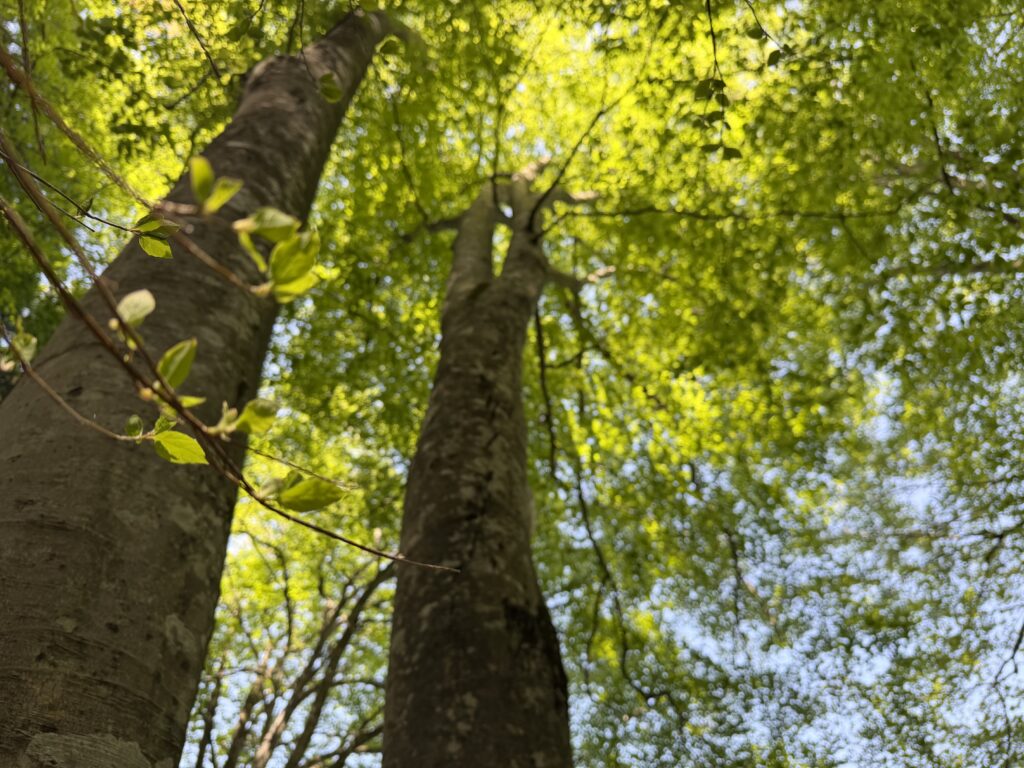
The second day was also sunny and clear. We entered the beech forest behind the village. This forest has been protected—with a strict prohibition on cutting down trees—to prevent avalanches from reaching the village. Beech trees over 20 meters tall stand in rows, including giant specimens estimated to be 200 years old. The young leaves covered the entire sky, creating a space enveloped in fresh green. The chirping of small birds echoed through the air.
Yap-Japan Cultural Exchange Program was held by Ecoplus from March 7 to 18, 2026, with a 10-day stay on the island. The participants included six female and two male university students. Due to the impact of Typhoon No. 3 (international name Nuri), which formed near Yap Island, the first half of the program involved setting up our living space and learning local life skills amidst heavy rain and wind. As the weather improved in the latter half, students were able to deepen their relationships with the local community.
We stayed in the Maap Community on the northern side of Yap Island. This is a place of fond memories, as it was where we held the first students program in 1992. Tim Moon, who coordinated the first program and was a member of the Department of Education at the time, lived right behind the women’s house that served as our base. Additionally, the children and grandchildren of the elders, Gaayan and Dukchul, who had supported us wholeheartedly since the very first program came one after another to look after us. For TAKANO Takako, Representative Director of Ecoplus, and OHMAE Junichi, Director—who have continued the program for over 30 years—this was a particularly special experience.
長老のラマンさん(左)からお話を聞く。ラマンさんは、過去お世話になったガアヤンさんの長男。Students listen to Elder Raman (left). Raman is the eldest son of Gaayan, who helped us in the past.
The participants stayed at the women’s house in Wonnet Village, a concrete building. At first, a few participants slept inside, but they found it more comfortable to sleep on the breezy patio. They then discovered that the traditional thatched-roof huts on the ocean side were even more comfortable, so half of them decided to sleep there. They were able to rest comfortably, sheltered from the rain.
We had asked the locals if they could share some fish and taro with us, and suddenly, they invited us to the sea. A net had been set in a spot where the water was only knee-deep at low tide, and when we searched the net, we found plenty of fish larger than the palm of our hands. Furthermore, fish had strayed into the seaweed beds that were beginning to dry out, leading to a scene where we chased the fish like a game of tag.
Furthermore, Chigei, who lives in front of the women’s house, appeared carrying fish—including a barracuda with sharp teeth over a meter long—from the sea and generously shared them with us.
いただいたバラクーダ。ラグーンの中でのトローリングで獲ってきたとのこと。A barracuda Chigei caught. He told us he caught it trawling in the lagoon.
We were also invited to a field on the land side to harvest taro. The leaves resemble those of Japanese small taro, but they had grown to a height far exceeding our own, providing enough shelter to withstand the heavy rain.
The coastline facing east has been hit by fierce waves due to rising sea levels. According to the elder, Raman, over the past 10 to 20 years, the coastline has shifted by several dozen meters, and about three rows of palm trees have been swept into the sea. During the major typhoon in 2004, waves crashed around the houses, eroding the foundations of even the concrete homes and washing the house away.
It was a program that also confronted us with harsh realities. The participants who have returned home are compiling their reflections and reports, and we will hold a debriefing session on Saturday afternoon, July 11. Details will be announced on this website at a later date.