On the weekend of May 23–24, 2014, Eco Plus held its weekend agricultural workshop, “ABC in a rice paddy” in Minamiuonuma City, Niigata Prefecture. Seventeen participants, ranging in age from 5 to their 70s—including families, office workers, and students from the Tokyo metropolitan area, Yamagata Prefecture, and even Okinawa Prefecture—took part.
On the 23rd, as we were heading out to observe the rice paddies, we spotted a large snake by the side of the road. It tried to escape by slithering into a hole, but we stepped on it and pinned it down. Fukasawa Kazuki , the wildlife expert serving as our instructor, happened to arrive just then and dragged the snake out to show everyone.
It was about 1.5 meters long and had a beautiful light green body. According to Mr. Fukasawa, it was a Japanese rat snake. He explained that, compared to the Japanese striped snake, it is generally more docile and less aggressive. He taught us how to hold it by the neck, and we took turns holding it.
The scales covering its entire body were dry but not hard, and we could clearly felt the firm muscles beneath them. He explained that about three-quarters of its body was its torso, and that its anus was located just below that. Two 5-year-old girls were also staring at the snake with big smiles on their faces.
In the rice paddies, large snails were moving across the water’s surface, leaving squiggly patterns in their wake. Water striders, tadpoles, small insects, and leeches were all moving about energetically.
We then moved to the high-altitude village of Tochikubo to observe young farmer Higuma Keiichi (39) planting rice. He was using an impressive rice transplanter capable of planting seven rows simultaneously. The rice paddy was narrow and had one protrusion, so Mr. Higuma had to maneuver the transplanter back and forth and side to side repeatedly as he planted. As he was leaving the field at the end, he demonstrated a technique where he shifted his body to the very front of the planter to maintain balance while navigating the steep, uphill embankment.
On the second day, it rained through the night. It was cold enough to feel chilly during the 6:00 a.m. birdwatching session. However, after we began planting around 9:00 a.m., the rain gradually stopped, and blue skies began to appear.
This year, after a heavy snowfall in January, the warm weather in February and March caused the snow to melt all at once, resulting in low water levels in the mountain streams. We had been unable to finish leveling the rice paddies, but the rain that fell two days ago finally allowed us to complete the work.
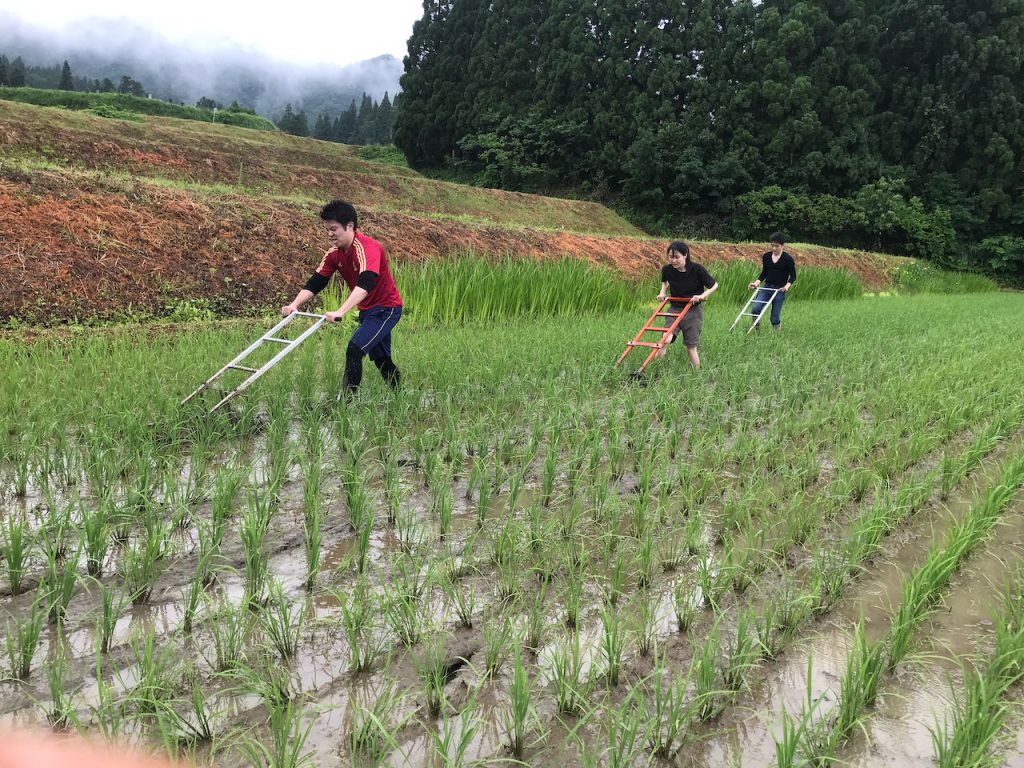
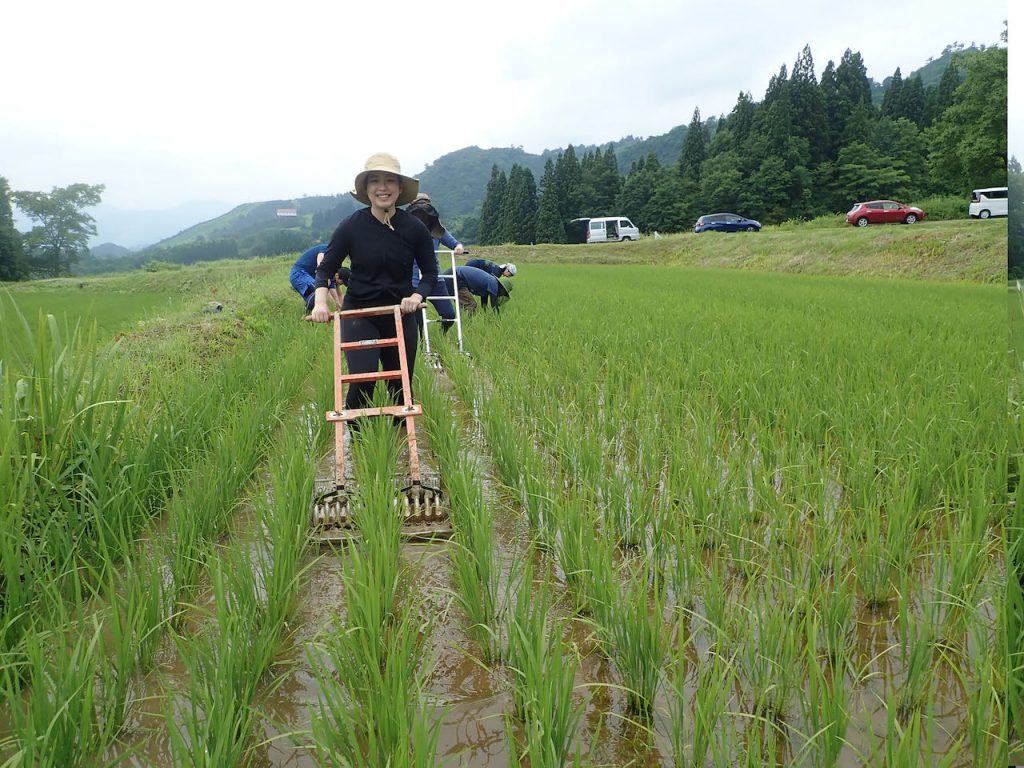
We rolled hexagonal frames to mark the lines and planted the seedlings in order at the intersections. One of the 5-year-olds initially cried and screamed because she didn’t want to put his feet in the mud, but after a while, she was walking back and forth across the rice paddy without a care. By the end, there was even a scene where two 5-year-olds and two young adults worked together to roll the frames.
Kato Yoshiharu, a local farmer who came to support us, explained the current situation, saying, “Everything has gone up in price this year, which is really tough. Fertilizer is one example, and rice transplanters have gone from 15 million yen last year to 20 million yen.” His words had a profound impact on the participants.
The next session, scheduled for June 20–21, will focus on weeding.
On the weekend of May 25 and 26, 2024, an Ecoplus Weekend Farming Workshop, “ABC in a Rice Paddy,” was held in Minamiuonuma City, Niigata Prefecture. Nineteen people from the Tokyo metropolitan area, Yamagata and Nagano prefectures participated, ranging from families with elementary school children to university students, young professionals, and senior citizens. Local farmers also supported the event. Under a blue sky, the participants enjoyed farming in chemical-free rice paddies while admiring the dazzling fresh green of Uonuma’s nature.
On the first day, we climbed to the 700-meter-high mountain pass commonly called “Kannon-sama” overlooking the Uonuma Basin to get an overall view of the Uonuma Basin. The mountains on the border of Gunma and Fukushima prefectures were clearly visible in the distance. A number of rare species of butterflies called “Gifucyo” danced around us. On the way back from the pass, we walked along the “old road” that UESUGI Kenshin took when he marched in the Kanto region. We actually walked through the terrain where the land had been hollowed out by the soldiers and horses, and we were reminded of the scene nearly 500 years ago.
The second day, we worked in the rice paddies. In one corner of the rice field were four seedbeds the size of one tatami mat. There, seedlings about 10 centimeters tall were growing in tight rows. Nowadays, seedlings are usually grown in greenhouses with warm conditions, and open-air “water seedbeds” have almost disappeared.
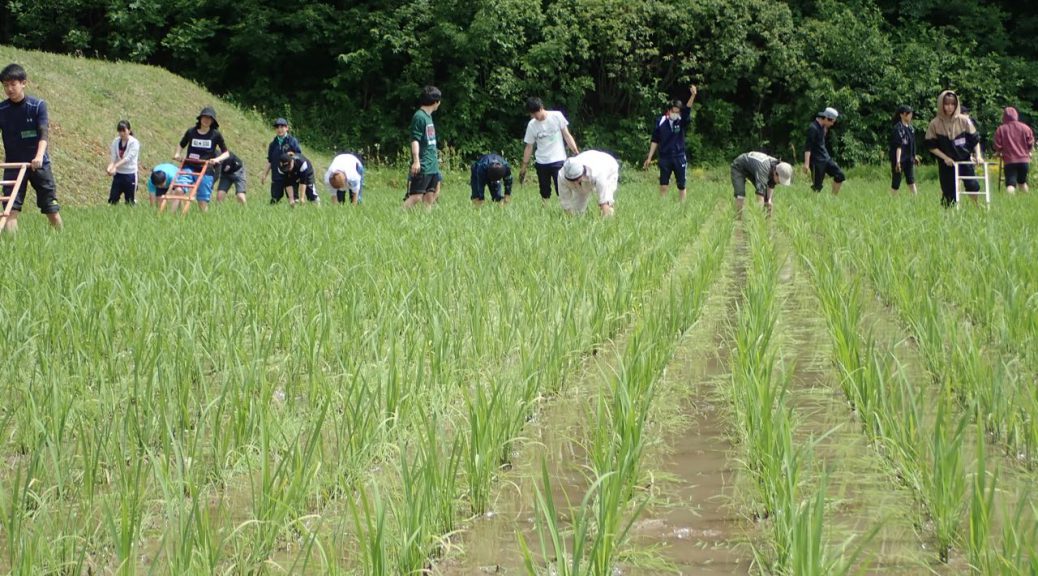
We took on the challenge of removing seedlings from this water nursery, a task that was commonplace until about 50 years ago. Bending over at the waist with both hands outstretched, we scooped out the seedlings as if we were scooping up the soil. The wild millet seedlings were growing in the seedbeds, so we had to identify and remove the millet seedlings. Both were so similar. The participants were challenged to identify the differences.
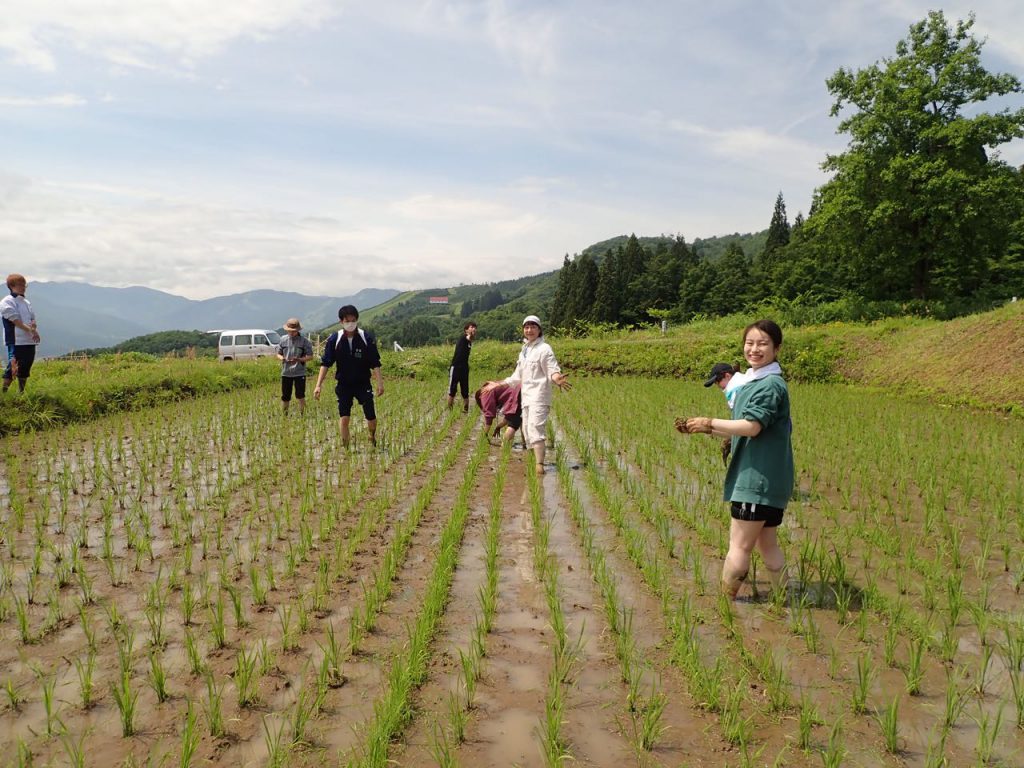
In the rice field where the rice was to be planted, a hexagonal wooden frame is rolled out to make a mark, and the seedlings are planted on the marks. The work of taking the seedlings, carrying them, and planting them unfolded fluidly as we all found ourselves sharing the work.
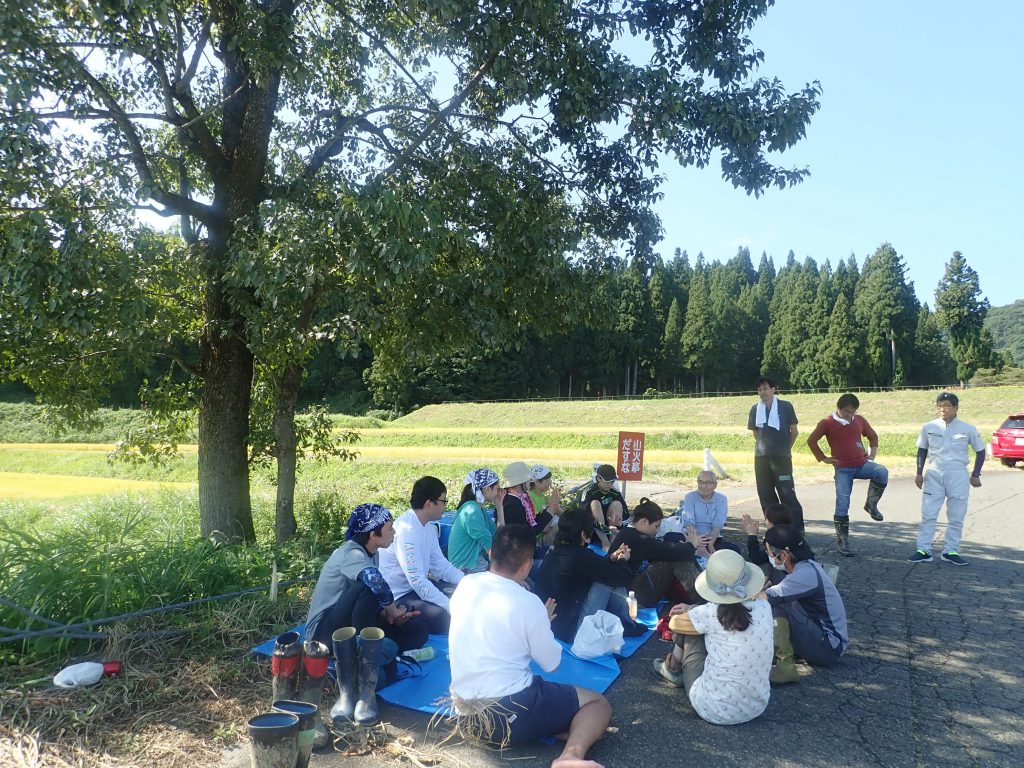
In about three hours, we finished the planting of about 150 square meters of rice. The participants then enjoyed a lunch of onigiri (rice balls) at the edge of the rice paddy. Participants left comments such as, “The feeling of putting my hands and feet in the mud made me wonder why I felt so happy,” and “I now understand how rice is grown.
On September 23 and 24, ECOPLUS will conduct “Rice Harvesting Workshop” in Tochikubo village, Minamiuonuma as two-day program, only with those who are PCR test negatives.
Summary Experience Japanese traditional rice harvesting by hands in organic rice paddy overseeing gorgeous mountainous view. Set your body and mind free in the safe open air. You may also deepen the insight of rice and agriculture through the workshop, as well as Japanese history and society.
Schedule Gathering; 11:00 am on September 23, at our accommodations, “Chateau Shiozawa.” The nearest railway station is Shiozawa on JR Joetsu line. Let us know if you use rain, so that we will arrange transportation to the hotel.
交通案内 23日午前8時52分東京駅発とき309号、10時21分越後湯沢着 10時30分越後湯沢発上越線普通列車長岡行、10時47分塩沢着 Joetsu Shinkansen Toki 309 Departing Tokyo at 08:52, arriving Echigo-Yuzawa at 10:21 Joetsu local line Departing Echigo-Yuzawa at 10:30, arriving Shiozawa at 10:47
Contents and bringing Harvasting rice by sickles by hands. Will be cancelled only in stormy condition. Bring your own lunch for day one. Clothings may get muddy. Insect repellent, a hat/cap. The boots are needed since it is very muddy. The participation guide will be provided for those whose participation is confirmed.
定員 Limit of participants. 20人をめどとします。Up to 20 participants.
参加費 Fee 18,500円(プログラム費、1泊2食の宿泊費、2日目の昼食、保険を含む)。男女別相部屋です。ご家族連れは調整させていただきます。1人部屋使用の場合は、1,000円増し。中学生以上大学生までは、13,500円。小学生は9,500円。地元からの参加で宿泊しない場合は、大人9,500円、学生4,500円、小学生は1,000円。 18,500 JPY including program fee, accommodations with two meals, lunch on Sunday, insurance. Shared room. Single room available with extra 1,000 JPY. 13,500 JPY for students from Junior high to college, 9,500 JPY for primary school students.
申し込み Application 下のフォームからお申し込み下さい。Please use below application form. 問い合わせは、tappo@ecoplus.jpまで。If needed contact to tappo@ecoplus.jp
ECOPLUS conducted the rice planting workshop on the weekend of May 21-22 in Tochikubo village in Minami-Uonuma, Niigata. The workshop had been shrunk as one day trip because of the COVID-19 and this was the first time to organize as the full-program since 2019. For the rice planting workshop, from elementary school kids to retired person, in total of around 30 were joined.
On Saturday, we gathered at the “Chateau Hotel Ipponsugi“ near the village. We moved up to the top of the mountain ridge by cars and observed the view of the Uonuma basin which is the home of the famous “Koshihikari” rice. The mountain area was once a bottom of ancient ocean. According to the locals, the minerals once accumulated in the bottom of the ocean is still seeping out, then provides rich nutrition to the rice.
Through the mountain ridge, parts of ancient path since the medieval tome were remained. We strolled along the small part of the path which was still covered by snow. Edible mountain vegetables were also identified in the forest near the path.
In the Tochikubo village, Mr. FUEKI Akira gave us a lecture on rice growing focusing on rice planting period. Many works needed before the rice planting, like spreading organic fertilizer, tilling, fine tilling with water, selection of well grown seeds with salt water, making seed bed, and others. Participants were impressed by so many steps with well experienced skills and knowledges were hidden in daily life in rice farming.
At the dinner, local edible vegetable were offered in different dishes. Surprisingly, the long dinner table which was decorated with local vines with purple flower and arrangements of edible vegetables provided the atmosphere close to the nature. The dinner was followed b the slide show of different seasons of the area.
On Sunday, it was still raining in the breakfast time but when we arrived to the rice paddy, rain was almost stoped. At the begging, we used an hexagon wood frame with 3 miters wide to mark on the soil to identify where the seedlings should be sit. First, OHMAE of ECOPLUS made one round trip, then other participant followed. It was not easy to go straight. Elementary school kids and high school student also tried to roll the frame with the supporting calls.
Surrounded by the beautiful nature, we enjoyed traditional planting works in this non-chemical rice paddy. ウグイスの鳴き声などに包まれて、無農薬田んぼで伝統の技を体験しました。
Rice paddy was not so cold and we could feel the softness of the soil. In fact, bear feet would be the best to experience the rice planting. Big rubber boots would make big foot prints which might lay down planted seedlings. With bear feet, we could feel the difference of depth of the mud and difference of the quality of the soil.
Time by time, we had blue sky with beautiful sunshine. Participants accustomed to plant seedlings gradually then, all the rice paddy were filled with young seedling in order by the noon. The lunch was prepared by a local inn; rice balls, cooked mountain vegetables and miso-soup with different mountain vegetables.
Coming back the hotel, we had the reflection session. As a full program for two days, we had lecture and other activities in advance of the actual works in the rice paddy. Many participants said, with the enough background understandings, actual rice planting work was more meaningful experience. ECOPLUS also confirmed that the full program could offer deeper learning on rice, history, tradition. and sustainability.
Next workshop is scheduled on the weekend of June 11-12 with the theme of “weeding.”
On September 25 and 26 of 2021, ECOPLUS conducted harvesting workshop in an organic rice paddy in Tochikubo Village in Minamiuonuma, the heartland of the famous “Koshihikari-Rice,” in Niigata.
Considering the situation of COVID-19, we organized the program as a day program asking participants come to and leave from the paddy directly. All 23 participants were fully vaccinated.
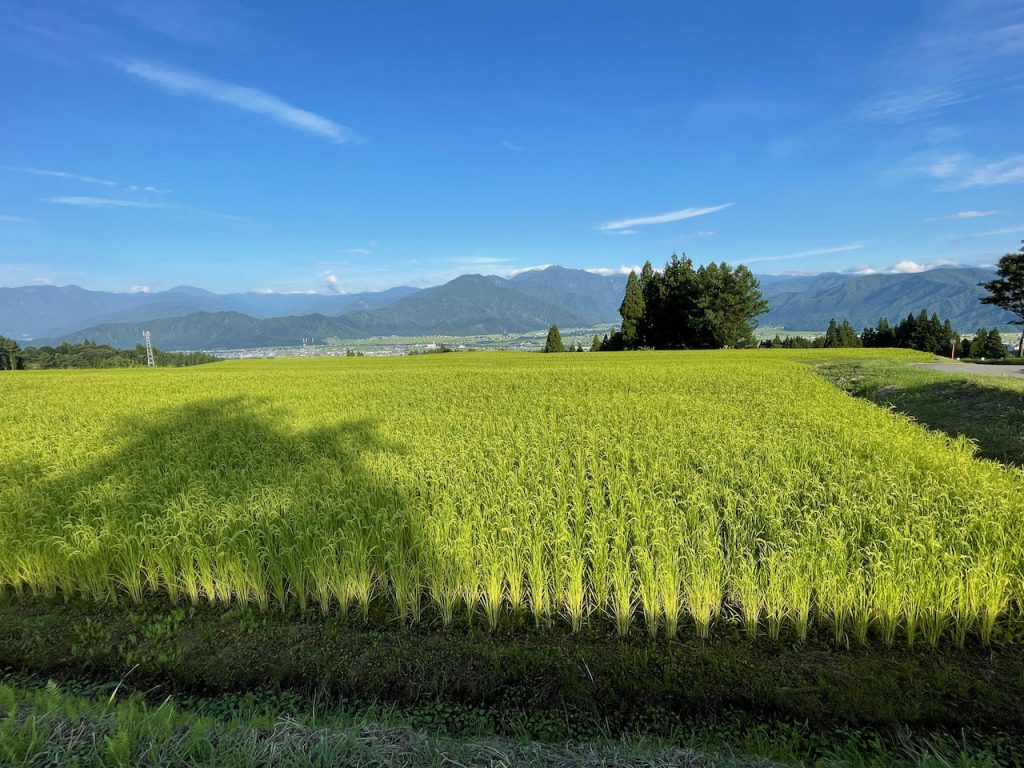
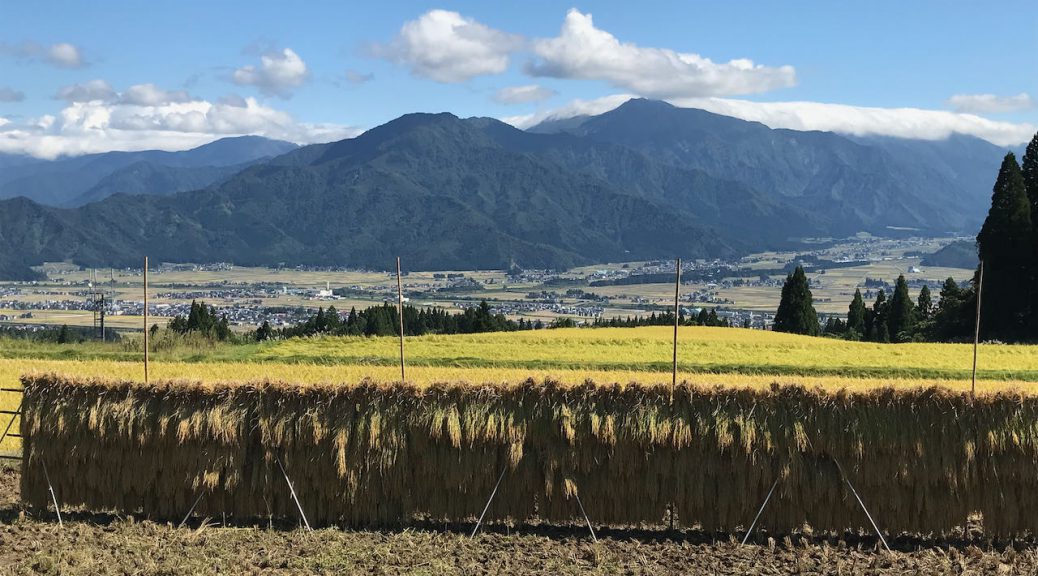
On Saturday, we had gorgeous view of golden rice paddy under the blue sky. In order to protect skin, we needed to wear long sleeves. The sunshine was so strong. All of us sweated from the beginning. Mr.FUEKI Akira, a local farmer, taught us the important and difficult skill, to bundle the sheaf, called “Meruke,” in this area.
More than half of participants were totally novice at using a sickle. At the beginning they were struggling to cut the stems clearly and to make “Maruke” in muddy rice paddy.
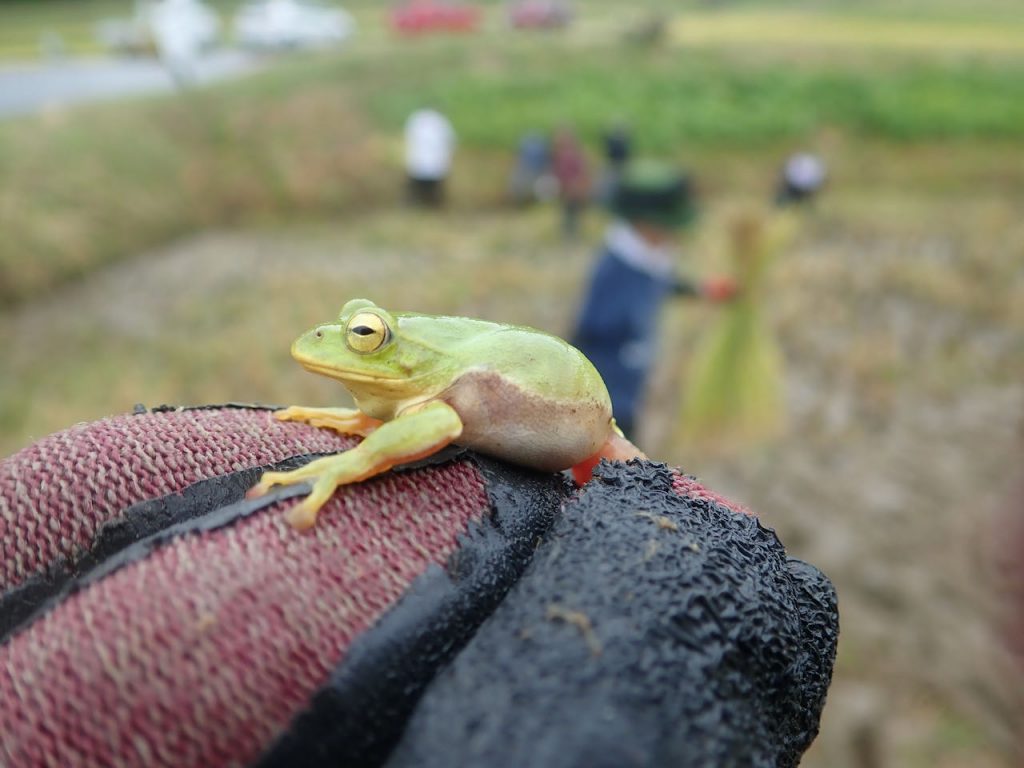
However in one hour or so, people acquired the ways. Some were just keep cutting and bundling works and some were doing the work taking neighboring persons joyfully. Fresh green colored frogs were jumping out from the ground. Red dragonflies were coming close to us. From a tiny structure to introduce water to the paddy, small fishes were caught and a local biologist explained those as one of endangered species in Japan, called “Shiny-Motsugo.”
On Sunday, weather condition totally changed. We started the work one hour earlier. It was cool and comfortable at the beginning. The work went smoother than the day before. Close to the noon, the rain started. The temperature went down, too. At the end, all of us worked hard to finish. Surprisingly we finished all works from cutting, budding and hanging by shortly after 1 pm.
“I somehow felt appreciation when I thought each of those grains was a ‘seed’ when I faced to those rice. The shining golden rice field might not be illusion. Rice was shining because they were celebrating the final phase to pass the life to the next generation;” a young participant commented.
The organic rice will be dried for 10 days to 2 weeks. Then husks will be removed and will be ready to eat. Only limited amount are available for interested persons.