No chemical materials, like pesticides and weed killers, were used. Fertilizer is 100% organic. Traditional sun drying process on the rack was taken. Because of so many hand works, such totally organic rice is almost vanished even in this Minamiuonuma, the heart land of famous “Koshihikari Rice.”
Polished 1,300 yen/kg and unpolished 1,200 yen/kg plus shipping. Rice grown with 80% less chemical is also available; polished 800 yen/kg, unpolished 700 yen/kg. Contact tappo@ecoplus or use the form below.
On June 12, 13, 19, 20, 26 and 27, ECOPLUS will conduct “Weeding Workshop” in Tochikubo village, Minamiuonuma as one-day program, only with those living in nearby cities or those who finished two weeks self quarantine or PCR negative persons. Come to the rice paddy with your lunch, drinks and snacks.
Summary Experience traditional weeding works in organic rice paddy overseeing gorgeous mountainous view. Have your shrunk body and mind by Covid-19 relieved in the safe open air field. You may also deepen the insight of food and farming through the workshop.
集合時刻 いずれも午前9時集合(遅くなる方は別途連絡を)。いずれも午後3時ごろには終える予定です。
Schedule Gathering; 09:00 am, if you come later just inform us. Closed around 03:00 pm.
Contents and bringing Weeding by hands. Will be cancelled in stormy condition. Take your own lunch, drinks and snacks. Clothings might be get muddy. Insect repellent, hat/cap. We recommend to come into the paddy with bare feet to feel the soil directly. Beach sandals are also easy to wash your feet in a stream.
定員 Limit of participants. 20人をめどとします。We will only have up to 20 participants a day.
参加にあたって For the participation 無農薬田んぼ応援のためのNPO法人エコプラスへの寄付(1人、1口3,000円以上)をお願いします。保険には入りませんので、ケガの場合はご自身の保険でお願いします。No fee for the program. We ask your contribution more than 3,000 Yens per person to support ECOPLUS for the support of organic rice farming.
On May 22 and 23, ECOPLUS will conduct “Rice Planting Workshop” in Tochikubo village, Minamiuonuma as one-day program, only with those living in nearby cities or those who finished two weeks self quarantine or PCR negative persons. Come to the rice paddy with your lunch, drinks and snacks.
Summary Experience Japanese traditional rice planting works by hands in organic rice paddy overseeing gorgeous mountainous view. Have your shrunk body and mind by Covid-19 relieved in the safe open air field. You may also deepen the insight of food and farming through the workshop.
Schedule Gathering; 09:00 am on May 22, if you come later just inform us. Closed around 03:00 pm. On 23, the schedule may ba changed based on the progress of works on 22.
Contents and bringing Planting seedlings by hands. Will be cancelled in stormy condition. Take your own lunch, drinks and snacks. Clothings might be get muddy. Insect repellent, hat/cap. We recommend to come into the paddy with bare feet to feel the soil directly. Beach sandals are also easy to wash your feet in a stream.
定員 Limit of participants. 20人をめどとします。We will only have up to 20 participants a day.
参加にあたって For the participation 無農薬田んぼ応援のためのNPO法人エコプラスへの寄付(1人、1口3,000円以上)をお願いします。保険には入りませんので、ケガの場合はご自身の保険でお願いします。No fee for the program. We ask your contribution more than 3,000 Yens per person to support ECOPLUS for the support of organic rice farming.
Limited amount of sun-dried organic rice grown in our rice paddy and in next one is available.
No chemical materials, like pesticides and weed killer, were used. Fertilizer is 100% organic. Traditional sun drying process on the rack was taken. Because of so many hand works such totally organic rice is almost vanished even in this Minamiuonuma, the heart land of famous “Koshihikari Rice.”
Polished 1,300 yen/kg and unpolished 1,200 yen/kg plus shipping. Rice grown with 80% less chemical is also available; polished 800 yen/kg, unpolished 700 yen/kg. Contact tappo@ecoplus or use the form below.
On September 27 and 28 in 2020, ECOPLUS organized a workshop on harvesting organic rice as a part of “ABC in a rice paddy” in Tochitsubo village, Minamiuonuma , Nigata. Due to the situation of COVID-19, we conducted it as a voluntary participating event without overnight stay unlike the usual workshops. Through 2 days, 24 people participated in this event on the non-chemical rice paddy.
雨の中、刈った稲の束ね方を教わる。Learn how to tie the harvested sheaf of rice in the rain.
Under the very wet weather condition, participants needed to wear rain gears and boots. From Mr. FUEKI Akira who has been taking care of the rice paddies, we learned how to use sickles to harvest rice and the way to tie harvested rice with rice straw. His tying skill was eye-opening and it was just like magic.
We started harvesting….however, it did not go so easily! It was actually difficult to cut all the stems of rice with sickles clearly. Tying the harvested one with rice straw was another problem because it easily becomes loose if you don’t tie it correctly. In addition to this hard situation, the paddy field, which became bottomless swamp due to the rain, caught our legs even up to our knees and didn’t let it go. What you will see if you fall on the ground is your entire body covered with dirt. I assume this was the biggest point that made us suffer the most this time.
However, in less than 2 hours, we gradually started to get the hang of it. Some people were just concentrating on their work. Some people were working while having conversations with others.
1時間に10分ぐらい、雨が途切れ薄日が差すことも。Sometimes the rain stopped temporarily for10 minutes per hour, and we could see slight sunlight coming through the cloud.
As the time went, a sense of solidarity was created among the participants somehow; automatically we set the bluesheets near each of us as a halfway point to collect the harvest sheaf of rice so that we could minimize the walking distance on the muddy ground. Being in the line and doing a relay the sheaf of rice was also helpful in putting them on the rack to dry them easily. The sheaves of rice that were tied tightly didn’t get loosened even if it was treated roughly a little bit.
The creatures living in the paddy were an oasis for us having hard time due to working in a muddy and wet condition. “Schlegel’s Green Tree Frog” was an especially popular star among us. Even the girls who do not touch the insects usually were rubbing the frog who have such an adorable look of typical frog.
稲の間から登場してきたシュレーゲルアオガエル。目の上下が金色に輝き、体は鮮やかな黄緑。“Schlegel’s Green Tree Frog” who popped up from the middle of the sheaf of rice. The upper and down part of her eyes were shining gold and the body had a vivid yellow green colour.
無農薬の田んぼで、そして機械ではなく手で稲を刈るからこそ会える生き物たちなのです。
We could only see these creatures because it was on the paddy field without any pesticide and working with our own hands but not by the machine.
2日目も雨。かなり降ってきた。Rain again on the second day. It was raining strongly.
By the lunch time of the second day, the paddy field which has the size of 1,400㎡ was cleared completely and the rice were all hanged on the drying rack. That scenery was just so lovely to see and I could not help to have an image of newly harvested rice in my mind. Some of the participants made their minds saying “I want to experience planting rice next year but not only harvesting” I wonder what the liquid going down on the face was. Was it the rain water, sweat, or the tears? A sense of accomplishment was filling our mind at the end. Of course, muscle pain didn’t forget to suffer us the next morning though….! (reported by FUKUI Tomoyuki, translated by HASUMI Chigira)
ECOPLUS conducted workshops on weeding in our non-chemical rice paddy in the weekend of June 20 and 27-28 in Tochikubo village at Minamiuonuma, Niigata, Japan. In order to avoid the risks on COVID-19, the workshop, used to be conducted for two days staying in an inn in the village, was changed into one-day program. For the there days, in total 16 persons were gathered and enjoyed the work surrounded by the calls of Ruddy Kingfisher and Gray-faced buzzard.
In those rice paddies, farmers have not been using chemicals for over 15 years. So weeds are also very healthy. Specially “Inu-Bie” or Japanese millet, is so similar to rice that it was so difficult to identify which is which in the field.
Mr. FUEKI Akira, the chief of Tochikubo Panorama Farm taught us that rice has small fluffs surrounding the base of each leaf. So, we were concentrating our eyes very close to those plants before each weeding actions.
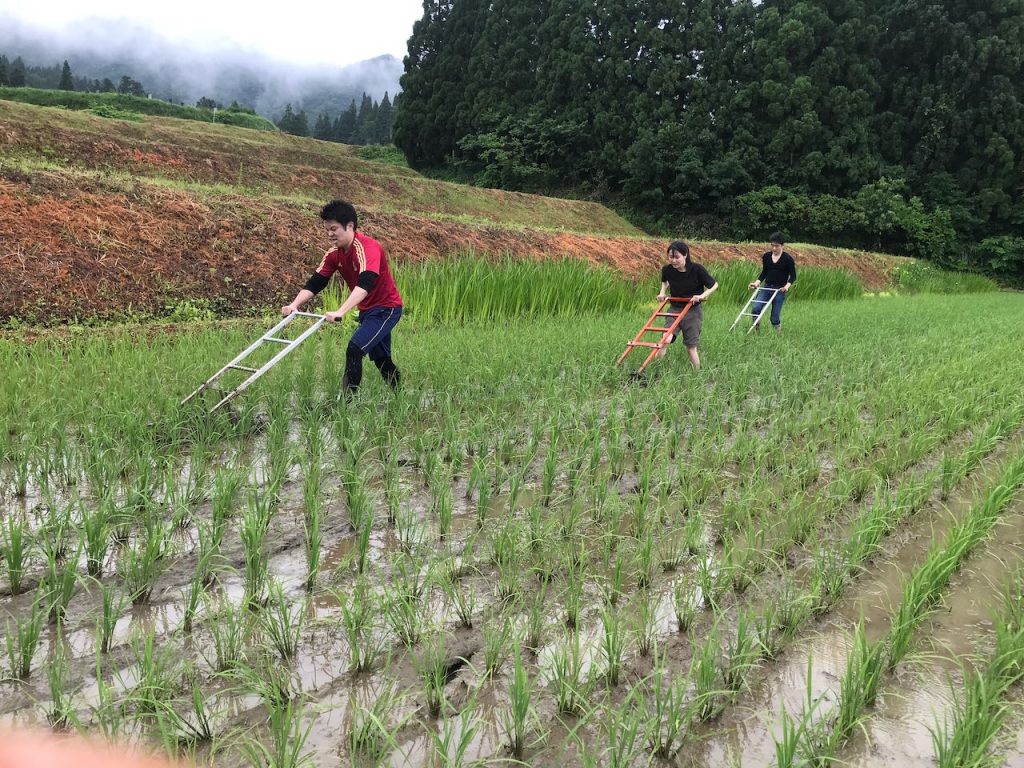
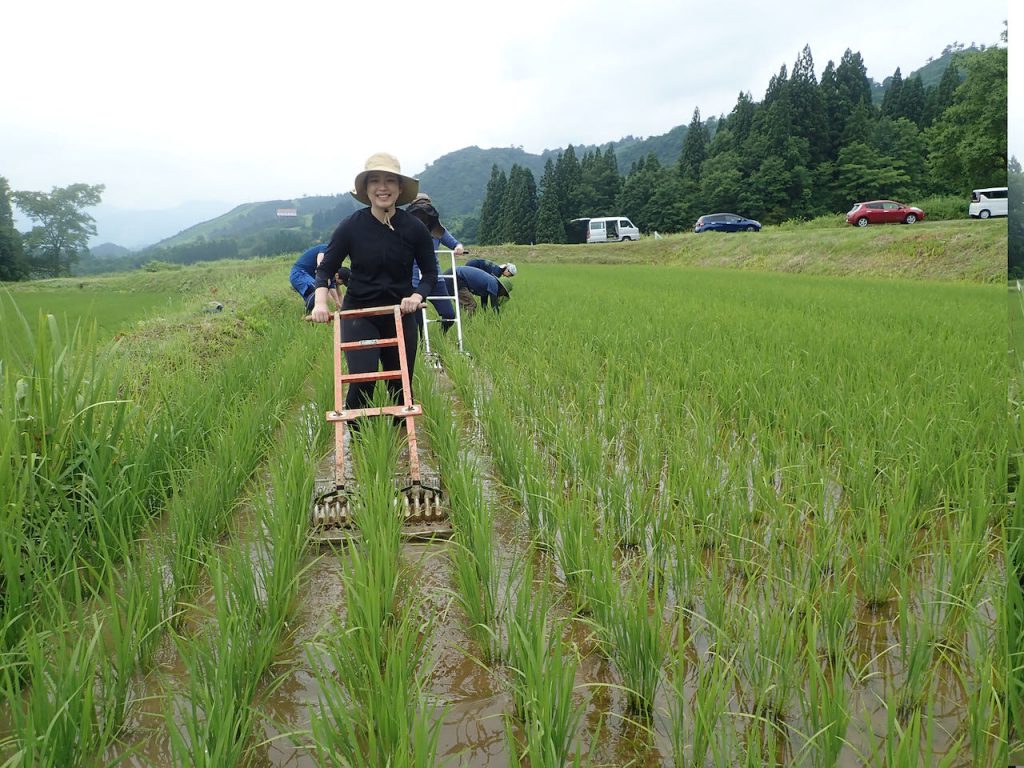
田車を押して縦方向の草を取る。 Using “Taguruma,” a special tool, weeds along the long side can be pulled out.
Some days before our works, farmers used special tool called “Taguruma,” which has metal rotating claws. So, weeds along the one side were already taken or less but another side was very congested with weeds.
直線方向はきれいだが、横方法に雑草が残る。Weeds between rice seedlings are still remained.
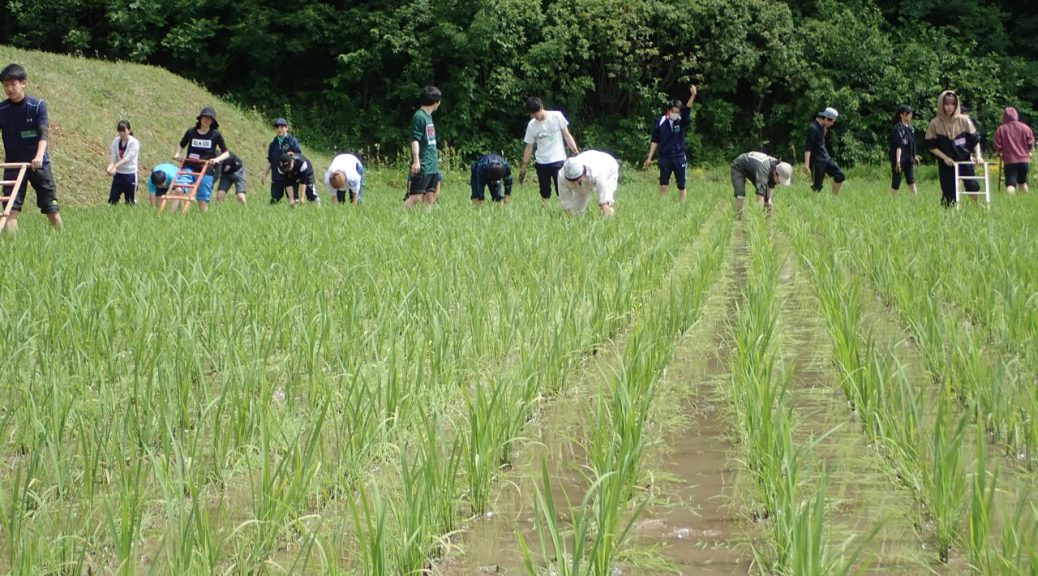
Weeds are grown as same as rice, we need to use all fingers pushed deep into the mud then pull out the weeds with roots. Keeping the bottom very low in the paddy during the work for more than one hour was quite tough for all of us.
Many of participants from Tokyo area repeated that “I never imagined it needs such hard work to grow rice organiclally.” Some university students, once said “I was doing football fo long years so I am confident on my physical strangeness,” complained of back pain.
While weeding, we identified so many dragonflies were emerging on the leaves of young rice. Some are totally transparent like a glassworks. All of us recognized the richness of the nature in the organic environment.
ECOPLUS conducted rice planting workshop on May 23, 2020, at Tochikubo village, Minamiuonuma, Niigata. Considering national emergency on COVID-19 situation, only Niigata locals joined the program although every year many participants from metropolitan area joined the program.
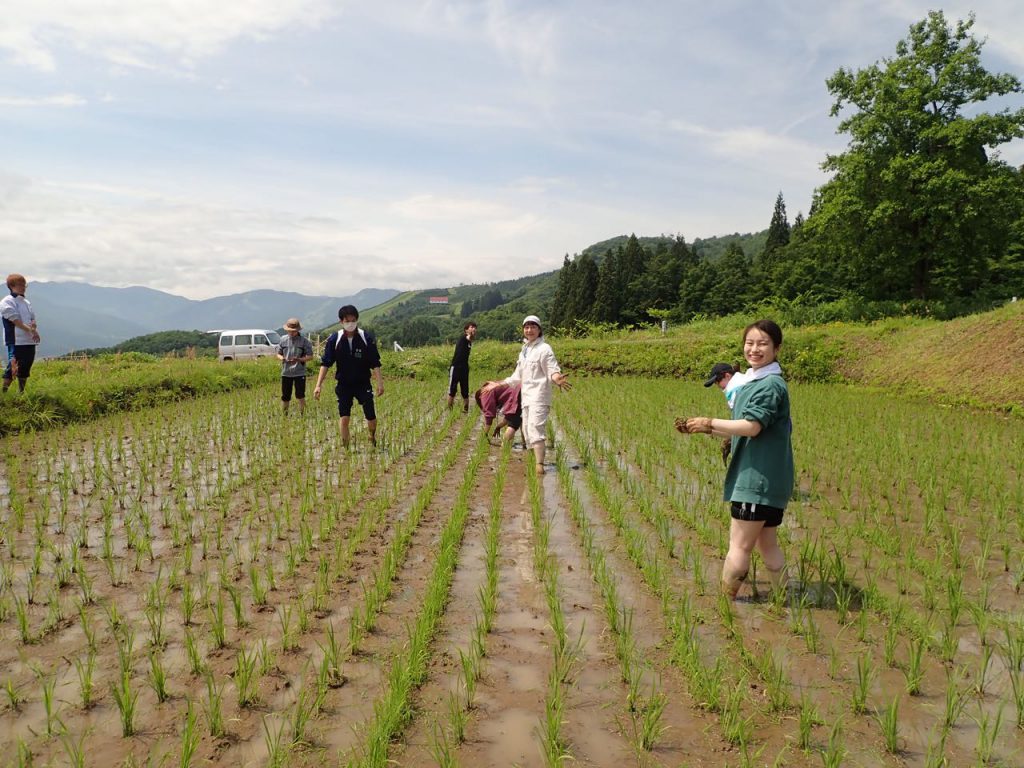
Total nine participants from university students to aged local ex-farmer stepped into the rice paddy with bare feet feeling warmed soft soil. We used old wooden framed to make marks on the soil so that young seedlings could be sit on each crossing section.