Suggested train schedule from Tokyo Joetsu Shinkansen Toki 309 Departing Tokyo at 08:52, arriving Echigo-Yuzawa at 10:20 Joetsu local line Departing Echigo-Yuzawa at 10:30, arriving Joetsu Kokusai Skiing Ground at 10:44
Contents and bringing Weeding by hands. Will be cancelled only in stormy condition. Bring your own lunch for Saturday, and water during activities. Clothings may get muddy. Insect repellent, a hat/cap. We recommend to come into the paddy with bare feet to feel the soil directly. Beach sandals are useful to wash your feet in a stream. More information will be provided for those whose participation is confirmed.
定員 Limit of participants. 15人程度。Up to around 15 participants.
参加費 Fee 一般:16,000円(プログラム費、1泊2食の宿泊費、2日目の昼食、保険を含む)。学生12,000円(同)。男女別相部屋です。ご家族連れは調整させていただきます。学生等で田んぼ脇の民家での寝袋泊も可、9,000円。宿泊なしの場合は、大人8,000円、小学生は1,000円。 16,000 JPY including program fee, accommodations with two meals, lunch on Sunday, insurance. Shared room. Students and other youth with sleeping bags can stay in a house next to the paddy with 9,000 JPY.
On the weekend of May 25 and 26, 2024, an Ecoplus Weekend Farming Workshop, “ABC in a Rice Paddy,” was held in Minamiuonuma City, Niigata Prefecture. Nineteen people from the Tokyo metropolitan area, Yamagata and Nagano prefectures participated, ranging from families with elementary school children to university students, young professionals, and senior citizens. Local farmers also supported the event. Under a blue sky, the participants enjoyed farming in chemical-free rice paddies while admiring the dazzling fresh green of Uonuma’s nature.
On the first day, we climbed to the 700-meter-high mountain pass commonly called “Kannon-sama” overlooking the Uonuma Basin to get an overall view of the Uonuma Basin. The mountains on the border of Gunma and Fukushima prefectures were clearly visible in the distance. A number of rare species of butterflies called “Gifucyo” danced around us. On the way back from the pass, we walked along the “old road” that UESUGI Kenshin took when he marched in the Kanto region. We actually walked through the terrain where the land had been hollowed out by the soldiers and horses, and we were reminded of the scene nearly 500 years ago.
The second day, we worked in the rice paddies. In one corner of the rice field were four seedbeds the size of one tatami mat. There, seedlings about 10 centimeters tall were growing in tight rows. Nowadays, seedlings are usually grown in greenhouses with warm conditions, and open-air “water seedbeds” have almost disappeared.
We took on the challenge of removing seedlings from this water nursery, a task that was commonplace until about 50 years ago. Bending over at the waist with both hands outstretched, we scooped out the seedlings as if we were scooping up the soil. The wild millet seedlings were growing in the seedbeds, so we had to identify and remove the millet seedlings. Both were so similar. The participants were challenged to identify the differences.
In the rice field where the rice was to be planted, a hexagonal wooden frame is rolled out to make a mark, and the seedlings are planted on the marks. The work of taking the seedlings, carrying them, and planting them unfolded fluidly as we all found ourselves sharing the work.
In about three hours, we finished the planting of about 150 square meters of rice. The participants then enjoyed a lunch of onigiri (rice balls) at the edge of the rice paddy. Participants left comments such as, “The feeling of putting my hands and feet in the mud made me wonder why I felt so happy,” and “I now understand how rice is grown.
ECOPLUS will organize the workshop, “ABC” in a Rice Paddy, in 2024. Although the climate is very curious, such as the snow melted one month earlier than normal years, we will conduct the programs as follows.
Rice planting; May 25-26 Weeding in the paddy; June 22-23 Harvesting; September 21-22 (tentative)
The rice paddy, we will conduct the program, was where TAKANO Takako and OHMAE Junichi has been learning the traditional rice growing by elders living nearby since 2007. Since no chemical materials has been used for nearly 20 years, many creatures such as pond snails, dragonflies, newts, loaches and others including listed species.
Last year, we successfully revived a nice paddy which had had not been cultivated for more than a decade. We will use the rice paddy this year, too.
昨年復田した10数年間使われてこなかった田んぼ。 A rice paddy, which had not been cultivated for more than a decade, was revived last year and will be used this year.
Suggested train schedule from Tokyo Joetsu Shinkansen Toki 309 Departing Tokyo at 08:52, arriving Echigo-Yuzawa at 10:20 Joetsu local line Departing Echigo-Yuzawa at 10:30, arriving Joetsu Kokusai Skiing Ground at 10:44
Contents and bringing Planting seedlings by hands. Will be cancelled only in stormy condition. Bring your own lunch for Saturday, and water during activities. Clothings may get muddy. Insect repellent, a hat/cap. We recommend to come into the paddy with bare feet to feel the soil directly. Beach sandals are useful to wash your feet in a stream. More information will be provided for those whose participation is confirmed.
定員 Limit of participants. 15人程度。Up to around 15 participants.
参加費 Fee 一般:16,000円(プログラム費、1泊2食の宿泊費、2日目の昼食、保険を含む)。学生12,000円(同)。男女別相部屋です。ご家族連れは調整させていただきます。学生等で田んぼ脇の民家での寝袋泊も可、9,000円。宿泊なしの場合は、大人8,000円、小学生は1,000円。 16,000 JPY including program fee, accommodations with two meals, lunch on Sunday, insurance. Shared room. Students and other youth with sleeping bags can stay in a house next to the paddy with 9,000 JPY.
The organic rice farming program in Tochikubo Village, which we have been organizing since 2007, can no longer continue. This is because the community farming organization has ceased operations due to the aging of the farmers.
Meanwhile, in Tochikubo, HIGUMA Keiichi, a farmer in his thirties, has started to work as a full-time farmer. With the support of his senior farmers, he has successfully managed the daily tasks of plowing with a tractor, daily water management, mowing of the edges, and processing the harvested rice, and has produced excellent rice.
Last year, we had a harsh climate with no rain from late July to the end of August. Only less than 5% of the Koshihikari rice in Niigata was first class, but Higuma’s rice was all first class.
The rice is “reduced pesticide rice,” which means that herbicides and other pesticides are not used. The price is 700 yen per kilo for brown rice, 800 yen per kilo for white rice, and shipping costs are not included.
ECOPLUS conducted the weekend farming workshop, “ABC in a rice paddy,” harvesting work, on 23-24 September 2023. Under the very unusual hot weather conditions, we learned about nature and agriculture in Shiozawa area, which is the heartland of famous Koshihikari rice, and enjoyed harvesting work by hand in non-chemical rice paddies.
標高500mの田んぼの脇でサワガニ発見 identified a fresh water crab
若手農家から今年の出来を聞く Hearing about the evaluation of rice of the year from a young farmer
稲刈りの田んぼの回りで自然観察 Observation of the nature around the rice paddies.
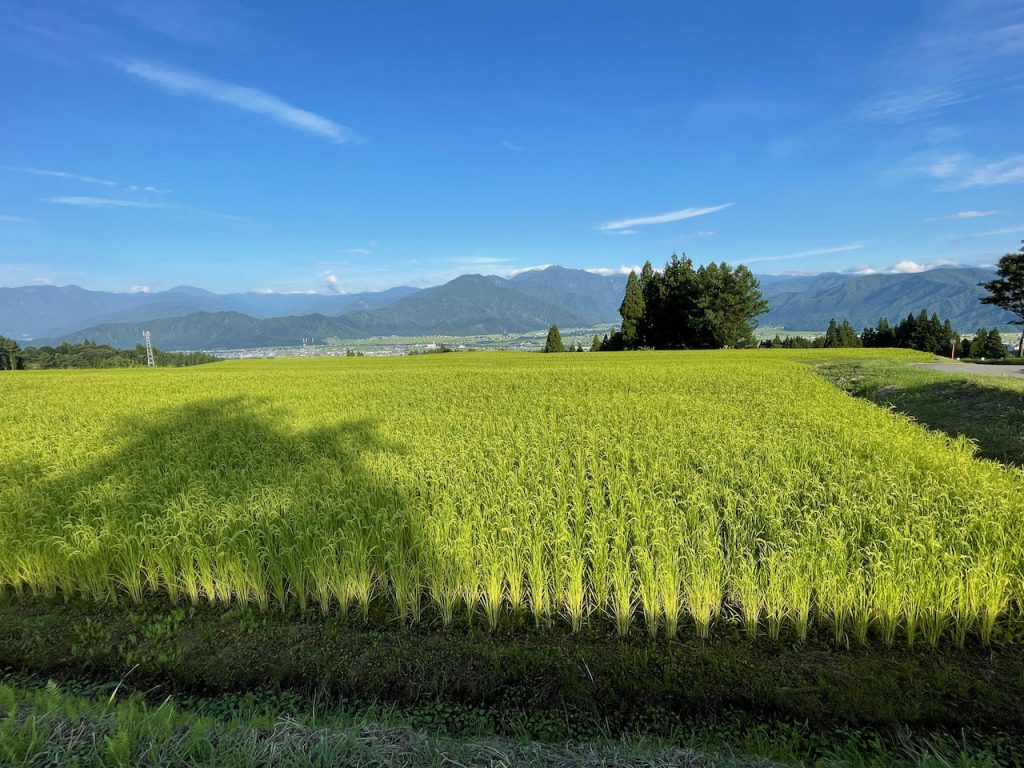
On Saturday, the 23rd, the weather was a bit wet. We went to the top of the hill called “Kwanon-sama” at an altitude of 700 meters to observe the Uonuma Basin. Rice fields with yellow (not yet harvested), brown (just harvested) and green (more than weeks after harvest with weeds) made a beautiful patchwork. The soil of the hill is raised seabed that provides minerals to the snow melted water in the spring. These minerals give the best flavor to the rice grown here.
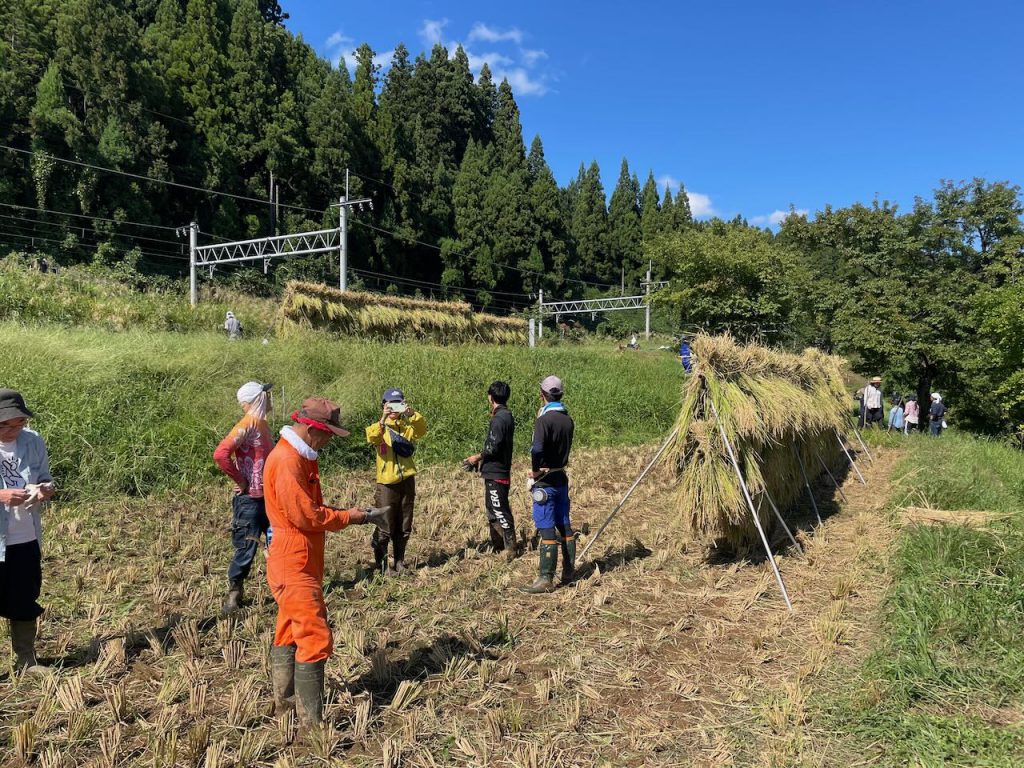
On Sunday the 24th we started harvesting under a beautiful blue sky. Among the 22 participants, only some had the experience of harvesting with sickles. They cut the bottom part of the rice stalks with sickles, then laid on the edge, crossed the bottom part in X-shape, then bundled two into one with dried straws. This was the most difficult part. Making the X shape makes it easier to hang the sheaf on the pole. One commented, “I understood that not only cutting, but also bundling and hanging must be done in one line.
By 1 pm, which took 4 hours from the beginning, the harvesting works of two rice paddies were completed. We set lunch place on the edge. Taking rice balls of newly harvested rice by the inn, all of us enjoyed talking about the value of rice and the beautiful environment in this area.
ECOPLUS will conduct rice harvesting workshop on 23-24 September 2023 in Kabanosa Village, Minamiuonuma, Niigata.We have been monitoring the growing process since the planting time. With this long hot and dry summer, ears are successfully coming out now. In this situation, in those weekend, the rice will be ready to be harvested.
Suggested train schedule from Tokyo Joetsu Shinkansen Toki 309 Departing Tokyo at 08:52, arriving Echigo-Yuzawa at 10:20 Joetsu local line Departing Echigo-Yuzawa at 10:30, arriving Joetsu Kokusai Skiing Ground at 10:44
Contents and bringing Weeding works by hands. Will be cancelled only in stormy condition. Bring your own lunch for Saturday, and water during activities. Clothings may get muddy. Insect repellent, a hat/cap. More information will be provided for those whose participation is confirmed.
定員 Limit of participants. 15人程度。Up to around 15 participants.
参加費 Fee 一般17,000円(プログラム費、1泊2食の宿泊費、2日目の昼食、保険を含む)。男女別相部屋です。ご家族連れは調整させていただきます。学生は14,000円。 宿泊なしの場合は、大人8,000円、小学生は1,000円。 17,000 JPY including program fee, accommodations with two meals, lunch on Sunday, insurance. Shared room. Students and other youth, 14,000 JPY.
申し込み Application 下のフォームからお申し込み下さい。Please use below application form. 問い合わせは、tappo@ecoplus.jpまで。If needed contact to tappo@ecoplus.jp
ECOPLUS conducted rice weeding and planting workshop on 10-11 June 2023 in Kabanoswa Village, Minamiuonuma, Niigata. Participants were so active that in addition to the weeding works, they also planted seedlings in another organic rice paddy. From the forest, tweets of a ruddy kingfisher were identified and in the evening, we observed several fireflies. Gorgeous weekend in the pristine environment!
On Saturday, we started the workshop with four participants at the beginning. Walking around the village and hiking up to the old fort of “Kabasawa-Zyo” which has the more than 450-year-history to understand the background of the area.
In the weeding workshop, participants put their bear feet carefully into the rice paddy. Thanks to the sun shine, the water was warmed up as if it would be a warm bath tub water and mud was very smooth. Seedlings were grown to about 20 cm tall and those were surrounded by tiny green leaves of weeds underwater. With five fingers strongly open, we were rubbing the mud to remove the roots of weeds out of mud. Some of weeds were trapped in the hand and we through away those outside of the paddy.
On day 2, with five more persons, we tried to plant seedlings in a rice paddy which had not been used for over 10 years. With the help of a tractor, the paddy was reshaped as a rice paddy, however the too much plants grown in the area were buried in the ground and those biodegrading process generated much of gas which is harmful for rice seedlings. After several tilling and drying processes, the condition looked like suitable for planting.
Making marks by a hexagon frames is the traditional way of rice planting in “Minami-Uonuma” area. It was not easy to roll the frame straight for participants. Some of young participants experienced the action. Others followed the frame to plant seedlings by their hands. At the end of the session, we identified three Japanese fire belly newt which is classified as the near threatened(NT) category in Red Data book of Japan.
Thought the weekend, we felt the richness of the nature surround the organic non-chemical rice paddies with tweets of ruddy kingfishes, dancing fireflies and others. Participants confirmed that the history of the village for over 500 years was fostered by the nature of the area and knowledge of ancestors who had been using the environment wisely.
ECOPLUS conducted rice planting workshop on 27-28 May 2023 in Kabanoswa Village, Minamiuonuma, Niigata. In past 16 years, we organized the program in nearby village, Tochikubo. Due to the aging issue of the village, the venue was moved to Kabanosawa from this season.
On Saturday, seven participants including students, office worker and retired person with local supporters, started to take out seedlings from seed beds in the rice paddy.
In the seedbed, seedlings were grown to around 10 cm high densely. Since late April when seeds were spread, temperature went down below 10 C some time. So the hight of the seedlings were bit low but stems were strong. In order to minimize damages of roots, not just pulling out, it needed to push fingers deeper in the mud, then to bring out seedling with mud. After washing mud with water, we made bunched of seedlings. Inside of young leaves, we identified several tiny golden dragonflies, a endangered species, “Mortonagrion selenion.”
The rice paddy, we will conduct the program, was where TAKANO Takako and OHMAE Junichi has been learning the traditional rice growing by elders living nearby since 2007. Since no chemical materials has been used for nearly 20 years, many creatures such as pond snails, dragonflies, newts, loaches and others including listed species.
枠転がし To put marks where seedlings should be sit, we used this hexagonal wooden frame.
On Sunday, we had an early morning bird watching session with a local specialist. We spotted gray herons, grey-faced buzzards and others. The walk to the top of the old fort, “Kabasawa-Zyo,” which once was serious battle field of Uesugi-clan and Hozyo-clan more than 400 years ago, gave us the sense of accumulation of peoples live in the area.
Suggested train schedule from Tokyo Joetsu Shinkansen Toki 309 Departing Tokyo at 08:52, arriving Echigo-Yuzawa at 10:20 Joetsu local line Departing Echigo-Yuzawa at 10:30, arriving Joetsu Kokusai Skiing Ground at 10:44
Contents and bringing Weeding works by hands. Will be cancelled only in stormy condition. Bring your own lunch for Saturday, and water during activities. Clothings may get muddy. Insect repellent, a hat/cap. We recommend to come into the paddy with bare feet to feel the soil directly. Beach sandals are useful to wash your feet in a stream. More information will be provided for those whose participation is confirmed.
定員 Limit of participants. 15人程度。Up to around 15 participants.
参加費 Fee 16,000円(プログラム費、1泊2食の宿泊費、2日目の昼食、保険を含む)。男女別相部屋です。ご家族連れは調整させていただきます。学生等で田んぼ脇の民家での寝袋泊も可、9,000円。宿泊なしの場合は、大人8,000円、小学生は1,000円。 16,000 JPY including program fee, accommodations with two meals, lunch on Sunday, insurance. Shared room. Students and other youth with sleeping bags can stay in a house next to the paddy with 9,000 JPY.
申し込み Application 下のフォームからお申し込み下さい。Please use below application form. 問い合わせは、tappo@ecoplus.jpまで。If needed contact to tappo@ecoplus.jp
ECOPLUS will organize the workshop, “ABC” in a Rice Paddy, in 2023. Although the climate is a bit curious., such as the snow melted 2-3 weeks earlier than normal years, we will conduct the programs as follows.
Rice planting; May 27-28 Weeding in the paddy; June 10-11 and other dates Harvesting; September 23-24 (tentative)
ECOPLUS had been organizing this special workshops in Tochikubo Village since 2007. Sadly, the aging issue caused villagers could not keep the farming works by themselves and those rice paddies in under the management of outside organization. So, we moved the place to Kabanosawa Village for the workshop this year 2023.
映画「地球交響曲第七番」の撮影にもこの田んぼで行われました。A movie, “Gaia Symphony No. 7” was shot in this paddy.
The rice paddy, we will conduct the program, was where TAKANO Takako and OHMAE Junichi has been learning the traditional rice growing by elders living nearby since 2007. Since no chemical materials has been used for nearly 20 years, many creatures such as pond snails, dragonflies, newts, loaches and others including listed species.
Suggested train schedule from Tokyo Joetsu Shinkansen Toki 309 Departing Tokyo at 08:52, arriving Echigo-Yuzawa at 10:20 Joetsu local line Departing Echigo-Yuzawa at 10:30, arriving Joetsu Kokusai Skiing Ground at 10:44
Contents and bringing Planting seedlings by hands. Will be cancelled only in stormy condition. Bring your own lunch for Saturday, and water during activities. Clothings may get muddy. Insect repellent, a hat/cap. We recommend to come into the paddy with bare feet to feel the soil directly. Beach sandals are useful to wash your feet in a stream. More information will be provided for those whose participation is confirmed.
定員 Limit of participants. 15人程度。Up to around 15 participants.
参加費 Fee 16,000円(プログラム費、1泊2食の宿泊費、2日目の昼食、保険を含む)。男女別相部屋です。ご家族連れは調整させていただきます。学生等で田んぼ脇の民家での寝袋泊も可、9,000円。宿泊なしの場合は、大人8,000円、小学生は1,000円。 16,000 JPY including program fee, accommodations with two meals, lunch on Sunday, insurance. Shared room. Students and other youth with sleeping bags can stay in a house next to the paddy with 9,000 JPY.
申し込み Application 下のフォームからお申し込み下さい。Please use below application form. 問い合わせは、tappo@ecoplus.jpまで。If needed contact to tappo@ecoplus.jp
On September 23 and 24, ECOPLUS will conduct “Rice Harvesting Workshop” in Tochikubo village, Minamiuonuma as two-day program, only with those who are PCR test negatives.
Summary Experience Japanese traditional rice harvesting by hands in organic rice paddy overseeing gorgeous mountainous view. Set your body and mind free in the safe open air. You may also deepen the insight of rice and agriculture through the workshop, as well as Japanese history and society.
Schedule Gathering; 11:00 am on September 23, at our accommodations, “Chateau Shiozawa.” The nearest railway station is Shiozawa on JR Joetsu line. Let us know if you use rain, so that we will arrange transportation to the hotel.
交通案内 23日午前8時52分東京駅発とき309号、10時21分越後湯沢着 10時30分越後湯沢発上越線普通列車長岡行、10時47分塩沢着 Joetsu Shinkansen Toki 309 Departing Tokyo at 08:52, arriving Echigo-Yuzawa at 10:21 Joetsu local line Departing Echigo-Yuzawa at 10:30, arriving Shiozawa at 10:47
Contents and bringing Harvasting rice by sickles by hands. Will be cancelled only in stormy condition. Bring your own lunch for day one. Clothings may get muddy. Insect repellent, a hat/cap. The boots are needed since it is very muddy. The participation guide will be provided for those whose participation is confirmed.
定員 Limit of participants. 20人をめどとします。Up to 20 participants.
参加費 Fee 18,500円(プログラム費、1泊2食の宿泊費、2日目の昼食、保険を含む)。男女別相部屋です。ご家族連れは調整させていただきます。1人部屋使用の場合は、1,000円増し。中学生以上大学生までは、13,500円。小学生は9,500円。地元からの参加で宿泊しない場合は、大人9,500円、学生4,500円、小学生は1,000円。 18,500 JPY including program fee, accommodations with two meals, lunch on Sunday, insurance. Shared room. Single room available with extra 1,000 JPY. 13,500 JPY for students from Junior high to college, 9,500 JPY for primary school students.
申し込み Application 下のフォームからお申し込み下さい。Please use below application form. 問い合わせは、tappo@ecoplus.jpまで。If needed contact to tappo@ecoplus.jp