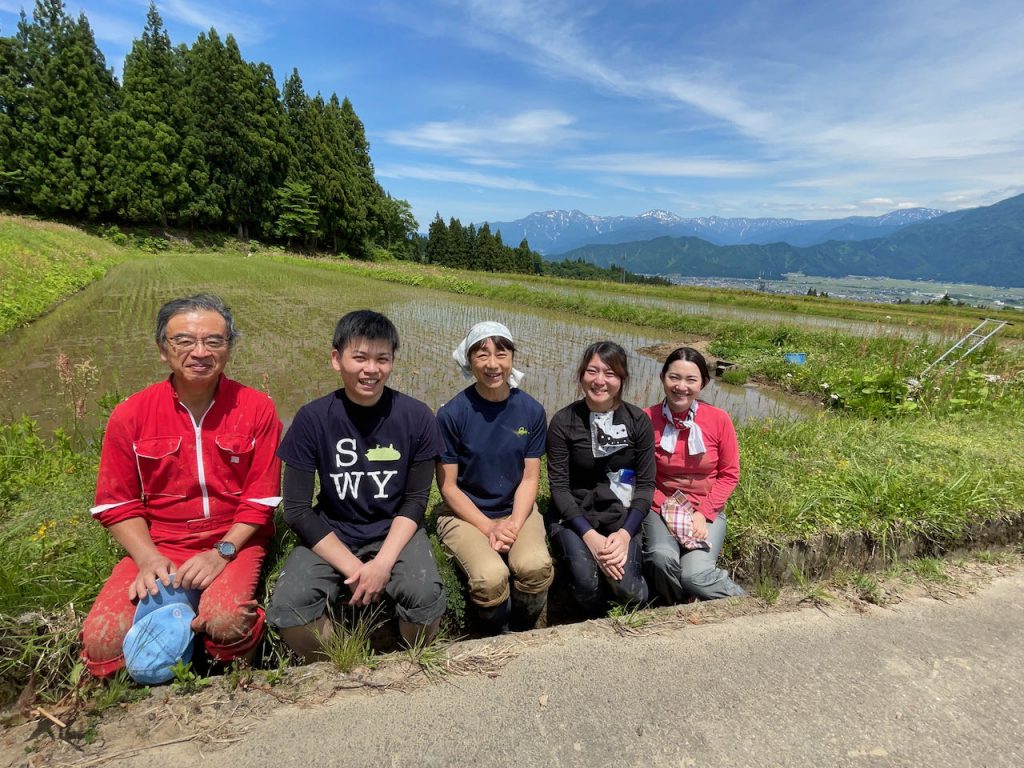
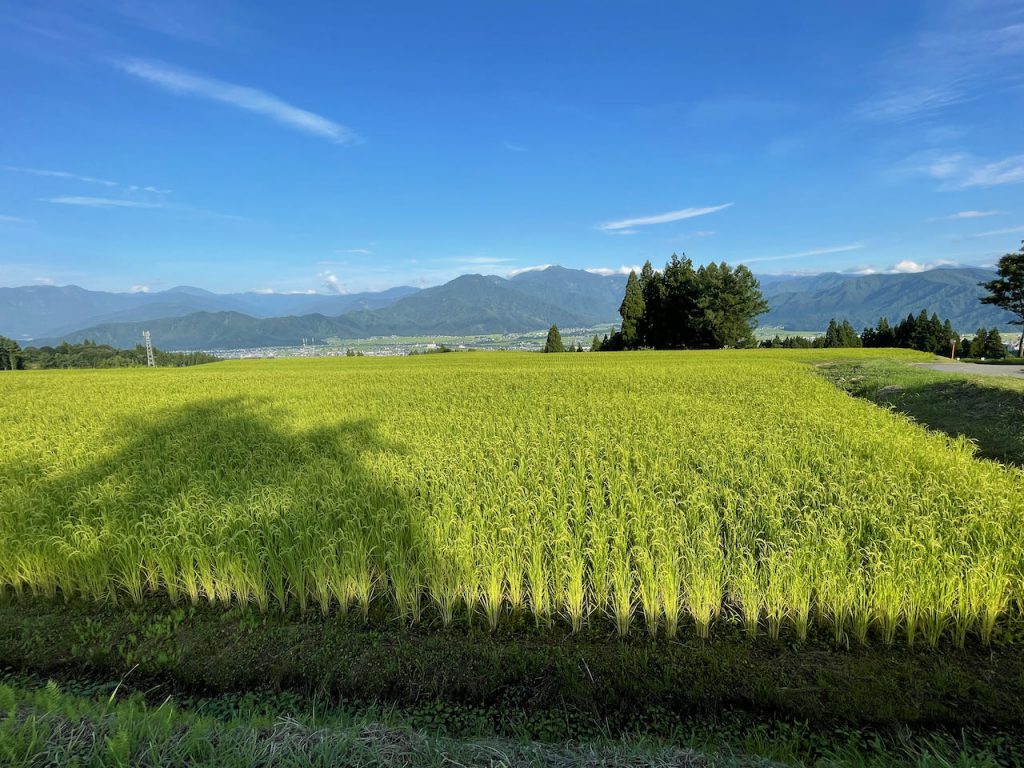
On the weekend of May 23–24, 2014, Eco Plus held its weekend agricultural workshop, “ABC in a rice paddy” in Minamiuonuma City, Niigata Prefecture. Seventeen participants, ranging in age from 5 to their 70s—including families, office workers, and students from the Tokyo metropolitan area, Yamagata Prefecture, and even Okinawa Prefecture—took part.
On the 23rd, as we were heading out to observe the rice paddies, we spotted a large snake by the side of the road. It tried to escape by slithering into a hole, but we stepped on it and pinned it down. Fukasawa Kazuki , the wildlife expert serving as our instructor, happened to arrive just then and dragged the snake out to show everyone.
It was about 1.5 meters long and had a beautiful light green body. According to Mr. Fukasawa, it was a Japanese rat snake. He explained that, compared to the Japanese striped snake, it is generally more docile and less aggressive. He taught us how to hold it by the neck, and we took turns holding it.
The scales covering its entire body were dry but not hard, and we could clearly felt the firm muscles beneath them. He explained that about three-quarters of its body was its torso, and that its anus was located just below that. Two 5-year-old girls were also staring at the snake with big smiles on their faces.
In the rice paddies, large snails were moving across the water’s surface, leaving squiggly patterns in their wake. Water striders, tadpoles, small insects, and leeches were all moving about energetically.
We then moved to the high-altitude village of Tochikubo to observe young farmer Higuma Keiichi (39) planting rice. He was using an impressive rice transplanter capable of planting seven rows simultaneously. The rice paddy was narrow and had one protrusion, so Mr. Higuma had to maneuver the transplanter back and forth and side to side repeatedly as he planted. As he was leaving the field at the end, he demonstrated a technique where he shifted his body to the very front of the planter to maintain balance while navigating the steep, uphill embankment.
On the second day, it rained through the night. It was cold enough to feel chilly during the 6:00 a.m. birdwatching session. However, after we began planting around 9:00 a.m., the rain gradually stopped, and blue skies began to appear.
This year, after a heavy snowfall in January, the warm weather in February and March caused the snow to melt all at once, resulting in low water levels in the mountain streams. We had been unable to finish leveling the rice paddies, but the rain that fell two days ago finally allowed us to complete the work.
We rolled hexagonal frames to mark the lines and planted the seedlings in order at the intersections. One of the 5-year-olds initially cried and screamed because she didn’t want to put his feet in the mud, but after a while, she was walking back and forth across the rice paddy without a care. By the end, there was even a scene where two 5-year-olds and two young adults worked together to roll the frames.
Kato Yoshiharu, a local farmer who came to support us, explained the current situation, saying, “Everything has gone up in price this year, which is really tough. Fertilizer is one example, and rice transplanters have gone from 15 million yen last year to 20 million yen.” His words had a profound impact on the participants.
The next session, scheduled for June 20–21, will focus on weeding.
The extraordinary rice shortage continues. The government is selling stored rice but still fundamental issues are not yet discussed and resolved. Learn about the origins of the rice world. We will review the current state of rice by “harvesting rice”, by hands in a 100% organic rice paddies.
The rice paddies for the program are which TAKANO Takako and OHMAE Junichi have been learning the traditional rice growing from elders living nearby since 2007. Without usage of chemical substances for nearly 20 years, we can observe many living creatures in the paddies such as pond snails, dragonflies, newts, loaches and others including listed species.
Suggested train schedule from Tokyo Joetsu Shinkansen Toki 309 Departing Tokyo at 08:52, arriving Echigo-Yuzawa at 10:20 Joetsu local line Departing Echigo-Yuzawa at 10:30, arriving Joetsu Kokusai Skiing Ground at 10:44
Contents and bringing Lectures and hands-on training on rice farming and the life and traditions of the rural community. The harvest occasion in the chemical-free rice paddies where we have been attentive since Spring. Bring your own lunch for Saturday, and water during activities. Clothings may get muddy. Insect repellent, a hat/cap. Rubber boots needed. More information will be provided for those whose participation is confirmed.
定員 Limit of participants. 15人程度。Up to around 15 participants.
参加費 Fee 一般:16,000円(プログラム費、1泊2食の宿泊費、2日目の昼食、保険を含む)。学生12,000円(同)。男女別相部屋です。ご家族連れは調整させていただきます。学生等で田んぼ脇の民家での寝袋泊も可、9,000円。宿泊なしの場合は、大人8,000円、小学生は1,000円。 16,000 JPY including program fee, accommodations with two meals, lunch on Sunday, insurance. Shared room. Students and other youth with sleeping bags can stay in a house next to the paddy with 9,000 JPY.
ECOPLUS will conduct the weekend faming workshop, “ABC in a rive paddy,” on 21-22 September in Minamiuonuma, Niigata. We are again having unstable climate until now including too hot and too long rainy condition. Now new ears of rice are coming out and the flowers of rice are fully blossoms. When accumulated daily mean temperature will reached to 950 -1000 in Celsius, it is the best time to harvest.
The workshop aims to re-think about so-called modern and convenient life style through hands-on experience in totally organic rice paddies and with the traditional way to grow rice. Using sickles, we will cut the stalks of the rice by hands and will tie sheaves to hang for sun-dry. Those activities are almost gone in industrialized faming now.
You can enjoy the strength of the stalks as you cut the stalks with a sickle, the weight of the sheaves on your shoulder and listen to the sound made by the grains touching each other.
Suggested train schedule from Tokyo Joetsu Shinkansen Toki 309 Departing Tokyo at 08:52, arriving Echigo-Yuzawa at 10:20 Joetsu local line Departing Echigo-Yuzawa at 10:30, arriving Joetsu Kokusai Skiing Ground at 10:44
Contents and bringing Harvesting by hands. Will be cancelled only in stormy condition. Bring your own lunch for Saturday, and water during activities. Clothings may get muddy. Insect repellent, a hat/cap. We recommend to come into the paddy with rubber boots. Boots rentals are available with 800 JPY. More information will be provided for those whose participation is confirmed.
定員 Limit of participants. 15人程度。Up to around 15 participants.
参加費 Fee 一般:16,000円(プログラム費、1泊2食の宿泊費、2日目の昼食、保険を含む)。学生12,000円(同)。男女別相部屋です。ご家族連れは調整させていただきます。学生等で田んぼ脇の民家での寝袋泊も可、9,000円。宿泊なしの場合は、大人8,000円、小学生は1,000円。 16,000 JPY including program fee, accommodations with two meals, lunch on Sunday, insurance. Shared room. Students and other youth with sleeping bags can stay in a house next to the paddy with 9,000 JPY.
Suggested train schedule from Tokyo Joetsu Shinkansen Toki 309 Departing Tokyo at 08:52, arriving Echigo-Yuzawa at 10:20 Joetsu local line Departing Echigo-Yuzawa at 10:30, arriving Joetsu Kokusai Skiing Ground at 10:44
Contents and bringing Weeding by hands. Will be cancelled only in stormy condition. Bring your own lunch for Saturday, and water during activities. Clothings may get muddy. Insect repellent, a hat/cap. We recommend to come into the paddy with bare feet to feel the soil directly. Beach sandals are useful to wash your feet in a stream. More information will be provided for those whose participation is confirmed.
定員 Limit of participants. 15人程度。Up to around 15 participants.
参加費 Fee 一般:16,000円(プログラム費、1泊2食の宿泊費、2日目の昼食、保険を含む)。学生12,000円(同)。男女別相部屋です。ご家族連れは調整させていただきます。学生等で田んぼ脇の民家での寝袋泊も可、9,000円。宿泊なしの場合は、大人8,000円、小学生は1,000円。 16,000 JPY including program fee, accommodations with two meals, lunch on Sunday, insurance. Shared room. Students and other youth with sleeping bags can stay in a house next to the paddy with 9,000 JPY.
On the weekend of May 25 and 26, 2024, an Ecoplus Weekend Farming Workshop, “ABC in a Rice Paddy,” was held in Minamiuonuma City, Niigata Prefecture. Nineteen people from the Tokyo metropolitan area, Yamagata and Nagano prefectures participated, ranging from families with elementary school children to university students, young professionals, and senior citizens. Local farmers also supported the event. Under a blue sky, the participants enjoyed farming in chemical-free rice paddies while admiring the dazzling fresh green of Uonuma’s nature.
On the first day, we climbed to the 700-meter-high mountain pass commonly called “Kannon-sama” overlooking the Uonuma Basin to get an overall view of the Uonuma Basin. The mountains on the border of Gunma and Fukushima prefectures were clearly visible in the distance. A number of rare species of butterflies called “Gifucyo” danced around us. On the way back from the pass, we walked along the “old road” that UESUGI Kenshin took when he marched in the Kanto region. We actually walked through the terrain where the land had been hollowed out by the soldiers and horses, and we were reminded of the scene nearly 500 years ago.
The second day, we worked in the rice paddies. In one corner of the rice field were four seedbeds the size of one tatami mat. There, seedlings about 10 centimeters tall were growing in tight rows. Nowadays, seedlings are usually grown in greenhouses with warm conditions, and open-air “water seedbeds” have almost disappeared.
We took on the challenge of removing seedlings from this water nursery, a task that was commonplace until about 50 years ago. Bending over at the waist with both hands outstretched, we scooped out the seedlings as if we were scooping up the soil. The wild millet seedlings were growing in the seedbeds, so we had to identify and remove the millet seedlings. Both were so similar. The participants were challenged to identify the differences.
In the rice field where the rice was to be planted, a hexagonal wooden frame is rolled out to make a mark, and the seedlings are planted on the marks. The work of taking the seedlings, carrying them, and planting them unfolded fluidly as we all found ourselves sharing the work.
In about three hours, we finished the planting of about 150 square meters of rice. The participants then enjoyed a lunch of onigiri (rice balls) at the edge of the rice paddy. Participants left comments such as, “The feeling of putting my hands and feet in the mud made me wonder why I felt so happy,” and “I now understand how rice is grown.
The organic rice farming program in Tochikubo Village, which we have been organizing since 2007, can no longer continue. This is because the community farming organization has ceased operations due to the aging of the farmers.
Meanwhile, in Tochikubo, HIGUMA Keiichi, a farmer in his thirties, has started to work as a full-time farmer. With the support of his senior farmers, he has successfully managed the daily tasks of plowing with a tractor, daily water management, mowing of the edges, and processing the harvested rice, and has produced excellent rice.
Last year, we had a harsh climate with no rain from late July to the end of August. Only less than 5% of the Koshihikari rice in Niigata was first class, but Higuma’s rice was all first class.
The rice is “reduced pesticide rice,” which means that herbicides and other pesticides are not used. The price is 700 yen per kilo for brown rice, 800 yen per kilo for white rice, and shipping costs are not included.
We are starting to accept orders of sun-dried organic ice grown in our non-chemical rice paddies in Tochikubo village in Niigata. The rice which will be harvested and dried under the sun, will be delivered in November.
From the planting of seedlings to weeding and harvesting, ECOPLUS has been organizing workshops. Very limited amount of this precious rice will be available for sale.
No chemical materials, like pesticides and weed killers, were used. Fertilizer is 100% organic. Traditional sun drying process on the rack was taken. Because of so many hand works, such totally organic rice is almost vanished even in this Minamiuonuma, the heart land of famous “Koshihikari Rice.”
Polished 1,300 yen/kg and unpolished 1,200 yen/kg plus shipping. Rice grown with 80% less chemical is also available; polished 800 yen/kg, unpolished 700 yen/kg. Contact tappo@ecoplus or use the form below.